
home > questionable doctrine > 607 : 1914 : seven times > methodology
607 : 1914 : Seven Times
Inconsistent Watchtower Methodology
There are numerous issues and inconsistencies with how Watchtower interprets the Seven Times. The major issue with how Watchtower arrives at 1914 is that Jerusalem did not fall in 607 B.C., as discussed at 607 B.C. or 587 B.C.? However, even if the assumption is made that 607 B.C. is correct, Watchtower's interpretation fails at a number of other levels.
- There is no reason to believe Daniel 4 has two fulfilments
- 606 B.C. or 607 B.C.
- 539 B.C. or 537 B.C.
- July or October
- 70 Weeks and the 7 Times
- 360 Day "Prophetic Year" for a Solar Year
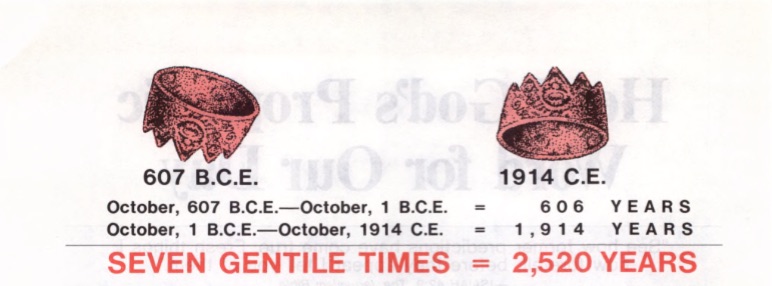
Daniel 4 - no Second Fulfilment
Further Articles Relating to
Seven Times, 607, 1914 & Last Days
Introduction to Seven Times Prophecy
607 B.C. or 587 B.C.
Inconsistent methodology
70 years - when were they?
History of the prophecy
Did the Last Days Start 1914?
Each prophecy in Daniel had only one fulfilment, as seen in the following list. However, the Watchtower claims Daniel 4:9-32 should have two fulfillments.
- Daniel 2: An immense image representing kingdoms
- Daniel 4: The "seven times" representing what befell Nebuchadnezzar - (and 1914?)
- Daniel 5: Writing on the wall foretelling Babylon's immediate destruction
- Daniel 7: Four beasts being 4 world powers
- Daniel 9: Seventy weeks and the Messiah
- Daniel 11: Kings of the North and South
Why attempt to impose upon Daniel 4 a second fulfilment, when all other Daniel prophecies had but one fulfilment? The dream was fulfilled on Nebuchadnezzar. Daniel 2, discusses an image with a head of gold, breast of silver, and so forth, showing the Babylonian king his kingdom would be followed by others. Daniel 3 is part of the sequence. Nebuchadnezzar builds the image he dreamt about, but this time it is gold from head to toe. In Daniel 4, Nebuchadnezzar behaves as a beast for 7 times. The key to this chapter is the end statement, where Nebuchadnezzar acknowledges that God owns the kingdoms and that Nebuchadnezzar only rules because God gave him that right. End of story. There is no basis for a secondary fulfilment. Nor is there any logic to the Watchtower connection, which uses the debasement of a heathen king to symbolise the debasement of God’s people.
Daniel 4:9-32 "'O Bel·te·shaz´zar the chief of the magic-practicing priests, because I myself well know that the spirit of the holy gods is in you and that there is no secret at all that is troubling you, tell [me] the visions of my dream that I have beheld and its interpretation. 10"'Now the visions of my head upon my bed I happened to be beholding, and, look! a tree in the midst of the earth, the height of which was immense. more...
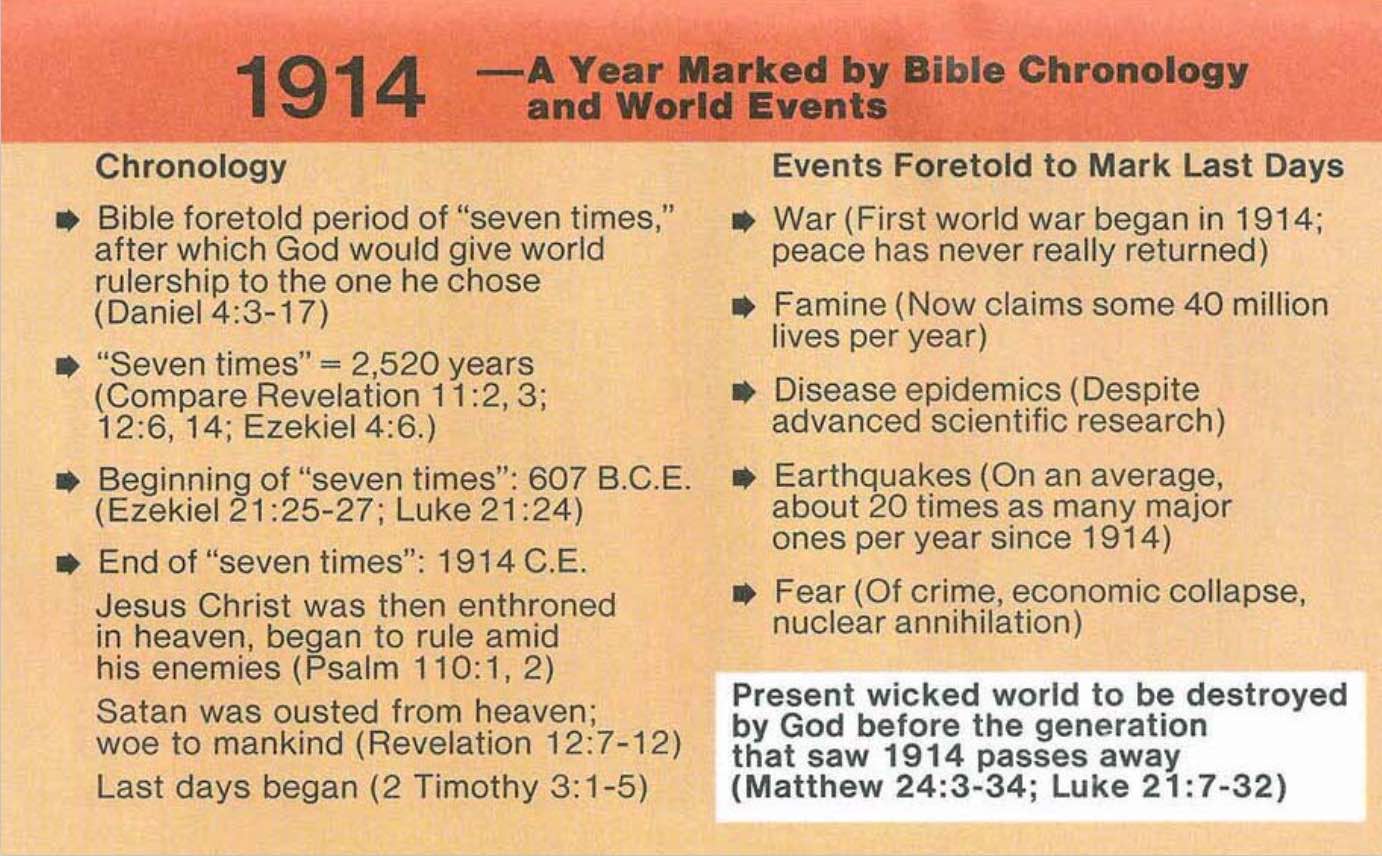
The Watchtower claims Daniel 4 prophesied the Gentile Times of the Nations, a period of time Jehovah did not have a kingly ruler. This extends from the end of God's rulership through the Jews in 607 B.C., until God re-established his Kingdom in heaven in 1914. The Gentile Times are the 2,520 year period in-between.
The interpretation of the secondary fulfilment goes as follows;
- The cutting down of the tree represents the destruction of the Kingdom of Judah by Nebuchadnezzar in 607 B.C.
- The "seven times" constitute 2,520 days, 7 years of only 360 days each
- The "principle" of "a day for a year" converts 2,520 days to 2,520 years
- The 2,520 years of the Gentile Times ended in 1914, coinciding with the start of Jesus' heavenly rulership
 Survival into a New Earth (1984) p.27
The term Gentile Times does not appear in Daniel 4, in fact it never appears in the New World Translation of the Holy Scriptures, yet is used over 500 times in the Watchtower during the 50 years between 1950 and 2002. The Watchtower bases its core kingdom message on a prophecy that is given a second fulfilment without precedence, based on a term it never uses. With such an eisegesis approach to interpretation, it is easy to see how Watchtower interprets the Bible to say whatever it wants it to say.
It takes significant imagination to deduce Daniel 4 should point to our time. There is no indication of a second fulfilment, no reference to the Israelites and no use of the terms Gentile Times or Last Days. Despite this, the prophecy of the seven times is the lynch pin of the Watchtower belief structure, as it is the only Scripture used to indicate that Jesus started ruling specifically in the year 1914.
Even if Daniel 4 was to have a secondary fulfilment, each aspect of the Watchtower calculation is based on misconceptions, discussed in detail throughout this section.
606 B.C. or 607 B.C.
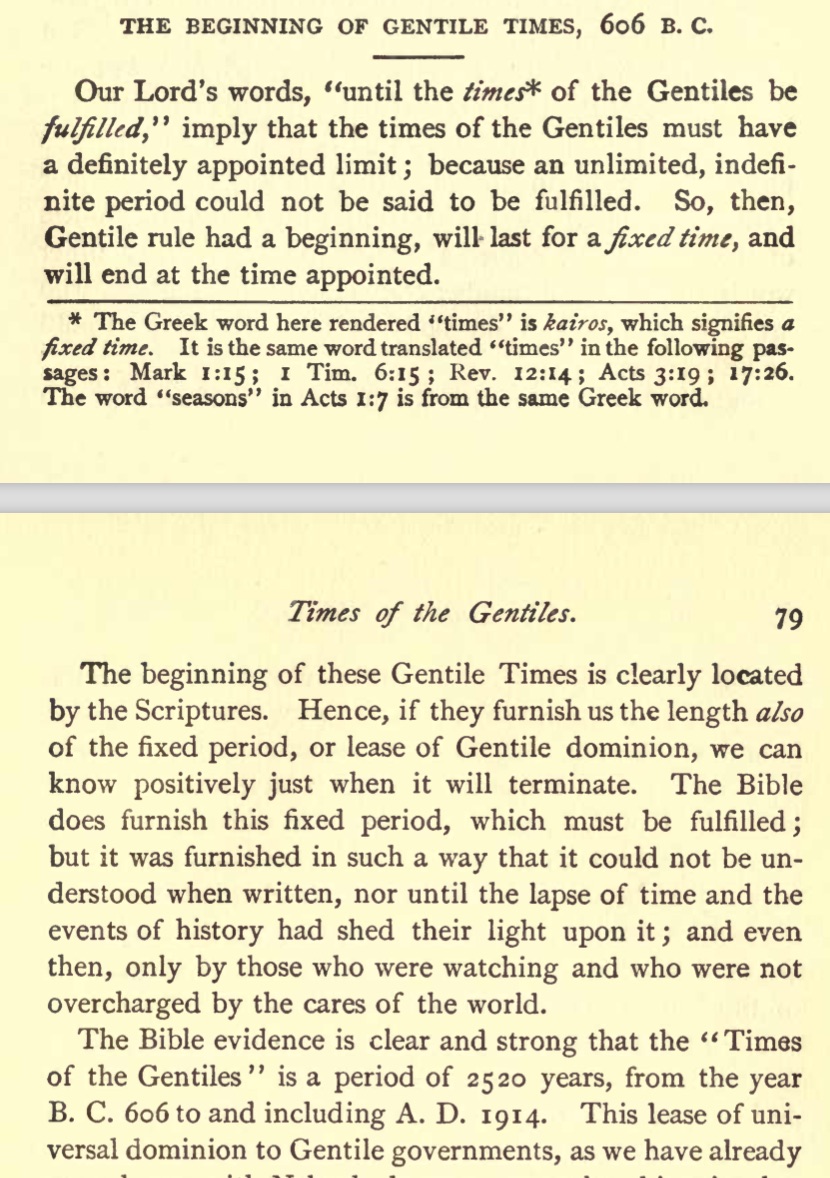
Russell believed the seventy years ended in 536 B.C. He counted back 70 years to 606 B.C., and claimed this was when Jerusalem was destroyed and the Seven Times commenced.
"THE SEVENTY YEARS OF DESOLATION This brings us to the period of the desolation of the land, which lasted seventy years, and was ended by the restoration of its people from Babylon, in the first year of Cyrus, B.C. 536 ..." Studies In the Scriptures Series II - The Time Is at Hand p.51
Studies In the Scriptures Series II - The Time Is at Hand pp.78-79
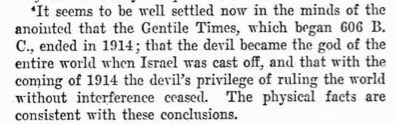
Under the rulership of Rutherford, it continued to be stated that Jerusalem fell in 606 B.C., with this year used as the basis for calculating 1914.
"It seems to be well settled now in the minds of the anointed that the Gentile Times, which began in 606 B.C., ended in 1914: ..." Watchtower 1925 Mar 1 p.67
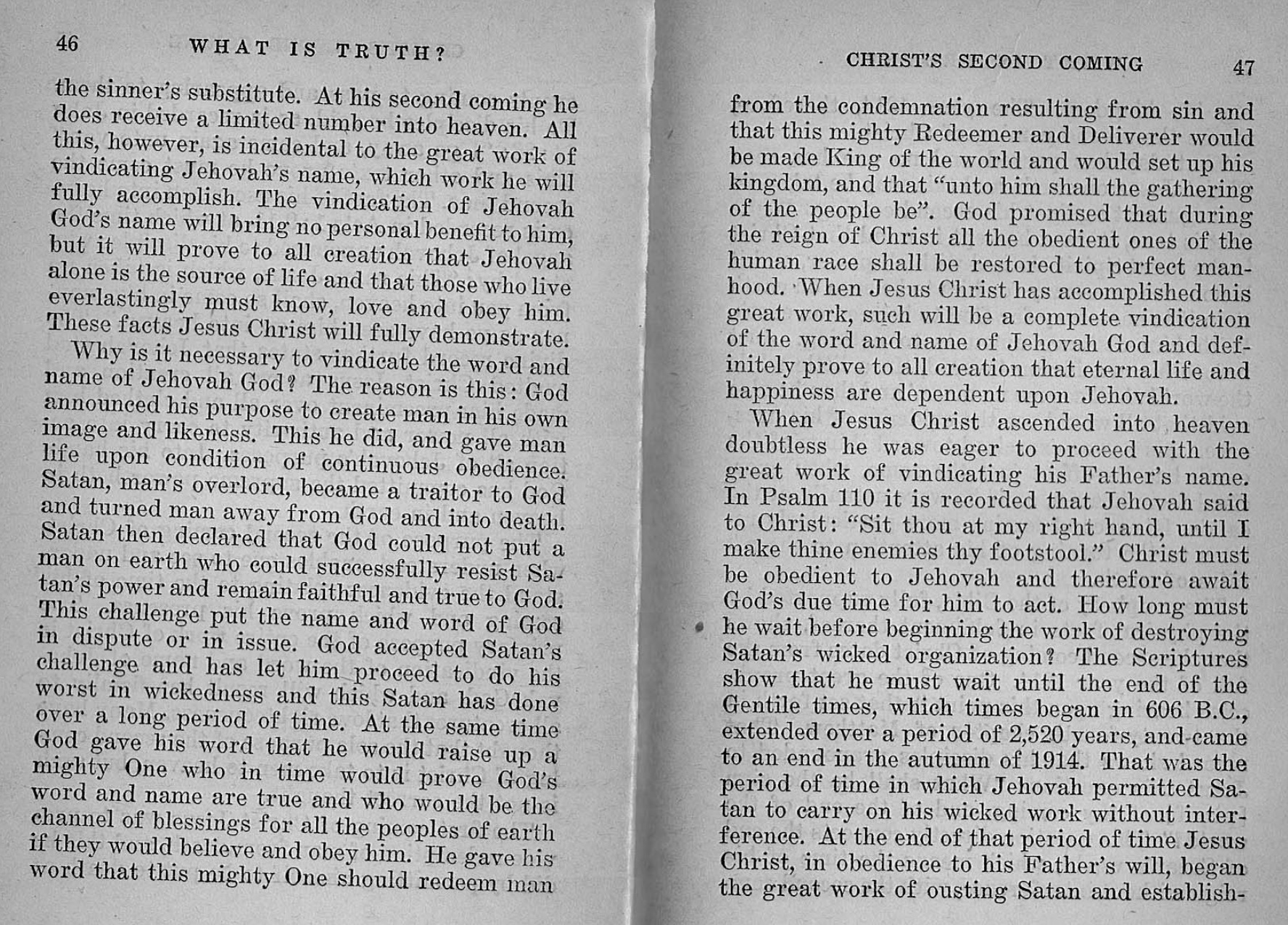
What is Truth, published in 1932 with Rutherford listed as the author, states;
"The Scriptures show that he must wait until the end of the Gentile times, which times began in 606 B.C., extended over a period of 2,520 years, and came to an end in the autumn of 1914." What is Truth (1932) p.47
The New World, published in 1942, still used 606 B.C. as the fall of Jerusalem.
"The Lord God used Nebuchadnezzar, the king of Babylon, as his executioner to do the overturning. That was in 606 B.C., and there the "seven times", the "times of the Gentiles", began." The New World (1942) p.77
It wasn't until 1943, a year after the death of Rutherford, that Watchtower admitted its calculations for the 2,520 years were inaccurate, because they had incorrectly factored a year zero between B.C. and A.D.. Rectifying this error meant that the Gentile Times started in 1915.
Since Watchtower had spent decades adamantly defending their calculations for the timeline around the destruction of Jerusalem, why isn't 1915 now used as the start of the Last Days? With so much vested interest in 1914, Watchtower leaders simultaneously changed the year they claimed Jerusalem fell from 606 B.C. to 607 B.C., and hence retain 1914. This required ending the seventy years in 537 B.C., instead of 536 B.C.
"Providentially, those Bible Students had not realized that there is no zero year between "B.C." and "A.D." Later, when research made it necessary to adjust B.C. 606 to 607 B.C.E., the zero year was also eliminated, so that the prediction held good at "A.D. 1914."-See "The Truth Shall Make You Free," published by the Watch Tower Society in 1943, page 239." Revelation - Its Grand Climax at Hand! p.105
Such an arbitrary move from 606 to 607, and 536 to 537, is only possible because the Watchtower does not deem it necessary to substantiate any of these years with historical proof. In fact, it uses these years despite significant evidence to the contrary, because 1914 is a critical foundation to the claim they alone were chosen in that year by Christ. If the Governing Body were to admit they lie about what Watchtower foretold was going to happen in 1914, and that 1914 has no historical or Scriptural basis, would undermine the faith of many of their followers.
Understanding that Watchtower arrived at 607 B.C.E. before it arrived at 537 B.C.E. helps identify the dishonesty in the following claim.
“That historical information is important to us in determining the beginning of “the appointed times of the nations.” Since the 70 years of desolation for Judah and Jerusalem ended in 537 B.C.E., they began in 607 B.C.E.” “Let your Kingdom Come” p.137
As the previous quotes show, 607 B.C.E. was decided as important before Watchtower started to say the desolation was in 537 B.C.E., and not the other way around as “Let your Kingdom Come” implies.
The difficulty with this move was that by the 1940's historians had proven that Babylon fell in 539 B.C., so it is interesting to see how Watchtower stretches this, out of the necessity of upholding 607 B.C.E., to 537 B.C.E.
539 B.C. or 537 B.C.
The Watchtower Society concurs that 539 B.C. is a pivotal year historically. However, when it changed the fall of Babylon from 536 B.C. to 539 B.C. it only moved the end of the 70 year period back to 537 B.C. To retain 607 and hence 1914, it concocts that the Jews arrived back in their homeland in 537 B.C.E.
""Thus, by the Fall of 537 BCE, the Jews had returned to Jerusalem to restore true worship. … There is strong evidence - and most scholars agree - that the Jewish exiles were back in their homeland by 537 B.C.E." Watchtower 2011 Oct 1 pp.28,31
The Watchtower feels free to make this unsubstantiated assertion without providing the backing of any evidence. It is not known when the Jews first arrived back in their homeland. It is just as simple to assert that the first Jews returned in 538 B.C.E or in 536 B.C.E, as many do.
The writer of 2 Chronicles and the writer of Ezra state that Cyrus released all captives some time during his first year. Babylon fell after the start of the civil year, which began Tishri 1 (September 27, 539 BCE, Julian). This means that his first year began on either the following Nisan 1 (March 24, 538 BCE) or Tishri 1 (September 17, 538 BCE). Some Bible writers use the Nisan calendar while others use the Tishri calendar, with evidence from Nehemiah suggesting the writer of Ezra-Nehemiah used the Tishri calendar.
2 Chronicles and Ezra do not state whether the decree was made by Cyrus early during his first year, or at its end. If he made it on March 24, 538 and the people took off immediately for the 4-month journey, settled in their towns and then walked to Jerusalem they could reach there by Tishri 1 (September 17, 538 BCE). Perhaps Cyrus made his declaration at the very end of his first year, and assuming his first year commenced Tishri 1 538, the Returnees would not get to Jerusalem until 536 B.C.E. No one knows, and the writers of Chronicles and Ezra show no interest in identifying the year.
The religious focus of Ezra made him deeply concerned at naming the people who made the journey, authenticating their genealogy, identifying their religious roles, and specifying their offerings towards the temple work. The only timing provided by Ezra was to the first day of the seventh month (Tishri), because of the religious significance of that day and of that month. Tishri marks the start of the civil year when several major religious celebrations take place, such as Yom Kippur.
It is revealing that the Bible writers did not provide information by which to date the Jews return to Jerusalem. This places the Watchtower in a position where it is required to guess at a year that is critical for determining their most fundamental doctrine.
A more significant problem with the claim of 537 is that the Bible shows the 70 years did not end with the return of the Jews, but rather at the destruction of Babylon in 539 B.C. Jeremiah 25:12 states the seventy years were fulfilled when Babylon is destroyed, not in an estimated year for the Jewish homecoming.
Jeremiah 25:12 "'And it must occur that when seventy years have been fulfilled I shall call to account against the king of Babylon and against that nation,' is the utterance of Jehovah, 'their error, even against the land of the Chal·de´ans, and I will make it desolate wastes to time indefinite."
July or October
Many Jehovah's Witnesses believe the start of World War One marked the end of the Gentile times and the start of the Last Days. After being cast from heaven, Satan set about creating "woe for the earth" (Rev 12:12) by starting the Great War, a clear indication he was now confined to the earth. This is incorrect, as World War One commenced over two months before the Gentile Times supposedly ended.
The events of 2nd October 1914 are unusual to consider now that over a century has passed.
“That was a highly interesting time because a few of us seriously thought we were going to heaven during the first week of that October.... Quite a few delegates stayed at Bethel, and, of course, members of the headquarters staff were present at the breakfast table on Friday morning, October 2. Everyone was seated when Brother Russell entered. As usual, he said cheerily, “Good morning, all.” But this particular morning was different. Instead of proceeding promptly to his seat, he clapped his hands and joyfully announced: “The Gentile times have ended; their kings have had their day.” “How we clapped our hands!” exclaims Cora Merrill. Brother Macmillan admitted: “We were highly excited and I would not have been surprised if at that moment we had just started up, that becoming the signal to begin ascending heavenward—but of course there was nothing like that, really.” Sister Merrill adds: “After a brief pause he [Russell] said: ‘Anyone disappointed? I’m not. Everything is moving right on schedule!’ Again we clapped our hands.”” Yearbook 1975 pp.72,73
"Let your Kingdom Come" outlines how Watchtower derived October 2.
"Historians calculate that Babylon fell in early October of the year 539 B.C.E. ... The inspired historical account tells us that the Jews responded readily to Cyrus’ decree, so that “when the seventh month arrived the sons of Israel were in their cities.” (Ezra 3:1) By our calendar that would be October, 537 B.C.E., which date therefore marks the completion of the foretold 70 years of desolation." ("Let your Kingdom Come" p.136)
The correlation is vague at best, since the Gentile Times is not said to start 537 B.C.E. but rather 70 years earlier in 607 B.C.E.
More importantly, World War One began two months prior to this, generally considered to have been July 28. The start of World War One therefore cannot be used by Jehovah's Witnesses as a sign of Jesus "presence", as it began prior to the Last Days.
In my pioneer school it was explained that World War One was Satan's 'smoke screen' to divert attention from Jesus coming Kingdom. This does not make sense as Jesus kingdom is presently invisible. There was nothing happening on earth that required "smoke screening". Neither does this reasoning have Scriptural backing, as Revelation says there would be woe for the earth and for the sea after Satan is cast down, not beforehand.
Most are unaware World War One started before the Gentile Times are said to have ended, and Watchtower does not alert to this fact, using World War One to support the Gentile Times started in 1914.
“The major fulfillment of that prophecy started with the desolating of the kingdom of Judah, which is indicated by Bible evidence to have been completed by October 607 B.C.E. Revelation 12:6, 14 shows that 3 1/2 times amounts to 1,260 days; hence, seven times (twice that number) must be 2,520 days. Reckoning “a day for a year,” we arrive at 2,520 years as the duration of the “seven times.” (Ezekiel 4:6) Therefore, Christ Jesus began his heavenly rule in the latter part of 1914. The erupting of the first world war in that year marked “a beginning of pangs of distress” that have continued to plague mankind.” Revelation - Its Grand Climax at Hand! pp.22-24
70 Weeks and the 7 Times
The 70 Weeks is a prophecy of Daniel used to indicate the time Jesus was to start his ministry. Some Witnesses have expressed to me they trust the interpretation of the Seven Times because it is determined using same methodology as Daniel's prophecy of the 70 Weeks.
This reasoning is without substance, as the calculation of the two prophecies varies considerably. The commonality between the two is that both use the formula of replacing a day for a year. After that the methodologies part ways.
Unique Interpretation: The Watchtower accepts the Christian understanding that the 70 Weeks pointed to Jesus. On the other hand, the Watchtower interpretation of the Seven Times is only adhered to by a small number of sects that trace their roots back to the 1800's Adventist movement.
Unique Secondary Fulfilment: The Watchtower agrees that the prophecy of the Seventy Weeks has only one fulfilment - the coming of the Messiah - whereas it claims the Seven Times should have two applications. The seven times clearly was fulfilled with the 7 year madness of King Nebuchadnezzar, the Watchtower is one of few religions that attempt to apply a secondary meaning to it.
Inconsistent Time Frame: The length of seventy weeks is easily calculated as being 490 days, and then a 'day for a year' is applied to extend it to 490 years. The seven times is not calculated in this method. By cross referencing to other scriptures a 'time' is said to represent a lunar 360 day year. The Watchtower inconsistently chooses when to apply a 360 day year or a 365 day year depending on the outcome they wish to achieve. (see Revelation and Daniel Prophecy.) In the seven times a lunar calendar is used to arrive at 2520 years, but then this is applied to a solar calendar to arrive at 1914.
Unverifiable: Jesus was visibly present at the time indicated by the prophecy of the 70 weeks and so the fulfilment is verifiable. The fulfilment of the 7 times is now said to have occurred invisibly, and as such was unnoticed by anyone other than the followers of Russell's teachings and unverifiable even by them.
360 Day "Prophetic Year" for a Solar Year
The principle of "a day for a year" was used regularly by Russell but is only occasionally adhered to in Rutherford's prophetic calculations. For instance, the Daniel prophecies of 1260, 1290 and 1355 days are all currently said to signify a day for a day, not a day for a year. Previously, Russell had interpreted these same prophecies with the concept of a day for a year, with results completely unrelated to current interpretation.
The 2,520 years are calculated by using a 360 day "prophetic calendar", supported by comparing a "time" from Daniel with Revelation. However, the Watchtower then applies the 2,520 years determined from a 360 day year to a 365.2425 day solar calendar to arrive at 1914. This is 2,556 "prophetic years". The Gregorian solar calendar the Watchtower depends upon for its calculations was not introduced until 1582 A.D.
Some scholars prefer consistent use of a "prophetic" calendar and convert 2,520 lunar years to 907,200 days. 907,200 days from 607 B.C. ended in 1878 A.D., a significant Adventist year.
It does not necessarily follow that a "prophetic year" is 360 days, as this is not a term found in the Bible, but a later product of Biblical interpretation. A lunar year is 354.37 days (12 x 29.53 days). Most ancient calendars based on the moon are lunisolar, as intercalary additions are required to stop them wandering across seasons. Ancient Judea had two different calendars, a 354-day lunisolar calendar that is still in use today as the traditional Hebrew calendar, and a 364-day schematic priestly calendar used by Enochic and Essene Judaism. The schematic calendar is considered sabbatical as 364 days is divisible by 7. To arrive at a 360 day year requires using a 364 day year and removing the four epagomenal days; the two solstices and the two equinoxes.

Ukrainian translation of this article.
Written 2007. Latest update February 2022.
 Paul Grundy 2005 - 2026