
home > questionable doctrine > 607 : 1914 : seven times > 607 or 587
607 : 1914 : Seven Times
607 B.C. or 587 B.C.?
Jerusalem fell in 587 B.C. This date is accepted by virtually all relevant scholars and encyclopaedia articles, due to the support of vast volumes of historical evidence. Watchtower claims 587 B.C. is wrong and Jerusalem was destroyed in 607 B.C.E. This is highly significant for Jehovah's Witnesses, as if Jerusalem was not destroyed in 607 B.C., then Jesus rulership did not commence in 1914, nor was Watchtower chosen in 1919.
Further Articles Relating to
Seven Times, 607, 1914 & Last Days
Introduction to Seven Times Prophecy
607 B.C. or 587 B.C.
Inconsistent methodology
70 years - when were they?
History of the prophecy
Did the Last Days Start 1914?
A large weight of evidence supports 587 B.C.,1 proving it impossible that Jerusalem fell in 607 B.C.. As early as 1929, Raymond Philip Dougherty's Nabonidus and Belshazzar (Yale University Press, p.10) wrote that the knowledge of the reign of these kings "is based upon more than two thousand dated cuneiform documents. It must therefore be accepted as the ultimate criterion in the determination of Neo-Babylonian chronological questions."
The Jewish year began in either April (Nisan – religious) or in September (Tishri – secular), and therefore does not align with our modern calendar and its January start. For this reason, the fall of Jerusalem is sometimes presented in the form 587/586 B.C.
There are numerous ways used to determine that Jerusalem fell in 587 B.C. This includes information from Ptolemy's Canon, the Nabonidus Chronicle, the ancient municipality of Harran, the Hillah stele (stone monument) and synchronization with Egyptian chronology.
The Dictionary of Biblical Archaeology, page 274 states "Archaeological evidence for the destruction of the kingdom in 586 B.C. comes from Jerusalem, Lachish, Tell Beit Mirsim, and other sites." Tens of thousands of detailed Economic-administrative and legal documents have been unearthed outlining daily, monthly and yearly occurrences during the reign of the Babylonian kings.
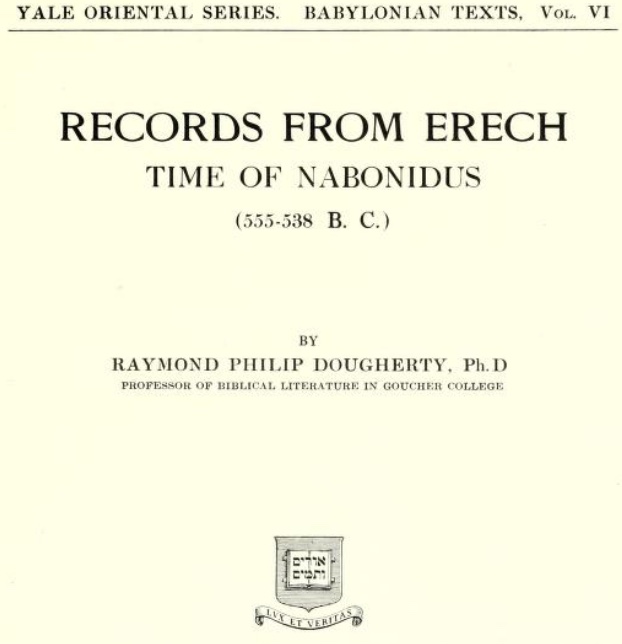
The book Records from Erech, Time of Nabonidus (555-538 B.C.) contains two hundred and forty-six texts from the temple archives of Erech, showing the level of detail kept during those times, data useful in an accurate dating of the time period.
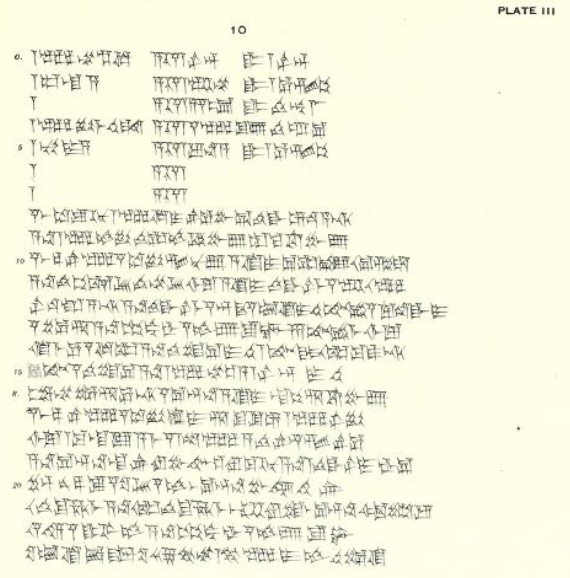
Prosopography is the study of careers and makes the Watchtower's addition of twenty years to Babylonian history unlikely due to the extending the life span of discovered Babylonians. A comparison of business people such as the Egibi business house with Watchtower chronology would require people mentioned in these records to have been working to over the age of 100. Likewise the Adad-guppi' stele would require the mother of Nabonidus to have lived until the age of 121.
The highly predicable nature of the stars and planets makes astronomical observations invaluable in dating prior events. Babylonians placed great importance on astrology and the thousands of records uncovered prove precisely the dates for the reign of Babylonian kings. VAT 4956 provides 30 observations, 5 of which place Nebuchadnezzar's 37th year as 568/67 B.C.E., making this an absolute date. This is significant as 2 Kings 25:2,8 places "the eleventh year of King Zedekiah" in "the nineteenth year of King Nebuchadnezzar", proving beyond doubt the date for the fall of Jerusalem.
For detailed evidence from Assyrian and Babylonian records proving that Jerusalem was destroyed in 587 B.C., see the book The Gentile Times Reconsidered.
Josephus
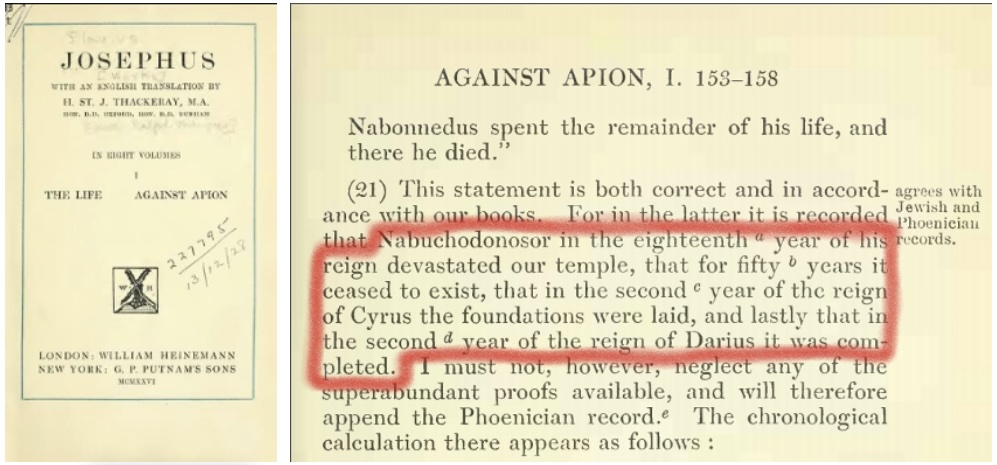
Josephus is in agreement with archaeological sources and can be used to show the Jewish destruction was in 587 B.C. He states that Jerusalem was desolate for only 50 years in Against Apion Book I, Chapter 21:
"Nebuchadnezzar, in the eighteenth year of his reign, laid our temple desolate, and so it lay in that state of obscurity for fifty years; but that in the second year of the reign of Cyrus its foundations were laid, and it was finished again in the second year of Darius ..."
Surprisingly the Watchtower tries to use Josephus to prove Jerusalem was destroyed in 607 B.C. In the Appendix of the Watchtower publication, Let Your Kingdom Come it quotes Josephus' Antiquities of the Jews Book XI , Chapter 1 (though the quote is actually from Book X):
"all Judea and Jerusalem, and the temple, continued to be a desert for seventy years,"
and Josephus Against Apion Book I, Chapter 19:
"our city was desolate during the interval of seventy years, until the days of Cyrus" (italics theirs).
By emphasising the word desolate the Watchtower Society hides the meaning of the sentence. If the emphasis is shifted to the word during, it shows Josephus may have meant the city was desolate for only part of that period.
The Watchtower reasoning makes Josephus works contradictory. There is no contradiction when understanding these passages to mean that Jerusalem was desolate for a period of 50 years during the 70 year desolation of the nations. This then agrees with Bible prophecy, with the explanation of the 70 years above and also with history.
Watchtower Refute
The Watchtower contrasts inspired "Bible Chronology" with uninspired "secular chronology". It claims that the above evidence for 587 B.C. cannot be trusted, because it disagrees with Bible prophecy. More accurately, secular chronology and the year 587 B.C. conflicts with Watchtower interpretation of Bible prophecy, which throughout these articles is shown to be flawed.
The Watchtower relies on scholars to arrive at 607, yet paradoxically claims those same scholars are wrong.
The explanation given is that the Bible is inspired and must therefore be taken above any secular source.
"If we follow the accurate timekeeping of Jehovah God as recorded in his Word, we see that the desolation of Judah ran from 607 to 537 B.C.E. and will thereby avoid making the mistake of the chronologers of Christendom who ignore the prophecy of the seventy years' desolation and date Jerusalem's destruction as occurring in 587 B.C.E. They limit the desolation of Jerusalem and the land of Judah to merely fifty years, accepting the unreliable calculations of pagan historians rather than the infallible Word of God." Watchtower 1965 Sep 15 p.569
"However, where the interpretation of these findings conflicts with clear statements in the Bible, we accept with confidence what the Holy Scriptures say, whether on matters related to chronology or any other topic." Watchtower 1989 Mar 15 p.22

Click on the image for a 22 page PDF that shows the Watchtower depends on the same astronomical tablets to arrive at 607 that it says are unreliable for arriving at 587.
This argument fails, because it is not a question of superiority of “Bible inspiration” over secular history, but rather of whether to accept the Watchtower’s interpretation of this Biblical passage. With the level of evidence against 607 B.C., it should serve as an alert that the Watchtower interpretation is incorrect, as is shown in a following article.
Furthermore, the Watchtower depends of secular sources for the date of 539 B.C., from which 607 B.C. is derived. In other words, the Watchtower starts with a date taken from secular sources (the 539 B.C. fall of Babylon), without acknowledging the methodology employed by the secular sources, and then applies upon it their own interpretation of Scripture.
To claim the historical evidence as wrong is both baseless and counter productive, as the Watchtower relies on these very same historical records to arrive at 607 B.C. The archaeological evidence that shows the destruction of Jerusalem was in 587 B.C. is the same evidence that the Society accepts as proof that 539 B.C. was the destruction of Babylon. The Watchtower determines 607 B.C. as the destruction of Jerusalem by accepting the historical records used to calculate when Babylon fell, and then working back 70 years from there. Archaeologists that prove when Babylon fell are the same people that have proven Jerusalem fell in 587 B.C. To undermine 587 B.C. is to also undermine 607 B.C.
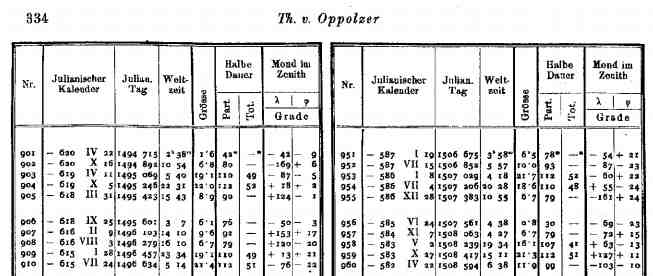
For example, to arrive at 539 B.C. for Babylon’s fall, Insight on the Scriptures relies upon an astronomical tablet and the work of scholars Strassmaier, Kugler, Oppolzer and Gingerich, to determine that King Cambyses’ 7th regnal year was 523/522 B.C.
Since its 15th April 1964 edition, the Watchtower uses the interchangeable abbreviations B.C.E. and C.E. in place of B.C. and A.D. The term Common Era traces back to 1615, and the abbreviation C.E. to the mid-19th century. B.C.E/C.E are becoming more common since the late twentieth century out of sensitivity to non-Christians.
"A Babylonian clay tablet is helpful for connecting Babylonian chronology with Biblical chronology. This tablet contains the following astronomical information for the seventh year of Cambyses II son of Cyrus II: … (Inschriften von Cambyses, König von Babylon, by J. N. Strassmaier, Leipzig, 1890, No. 400, lines 45-48; Sternkunde und Sterndienst in Babel , by F. X. Kugler, Münster, 1907, Vol. I, pp. 70, 71). … Thus, this tablet establishes the seventh year of Cambyses II as beginning in the spring of 523 BCE. This is an astronomically confirmed date." Insight on the Scriptures p.453
It is because of the extreme reliability of the information regarding the secular king lists that the Watchtower is able to depend on 539 B.C. as the fall of Babylon, upon which it applies simple maths to determine 607 B.C. as the fall of Jerusalem. After accepting the date calculated for the astronomical tablet from Cambyses’ 7th year, Insight then relies on the secular chronology, such as provided by Ptolemy’s Canon, to travel to the date of Babylon’s 539 B.C. fall.
"The date of 539 B.C.E. for the fall of Babylon can be arrived at not only by Ptolemy's canon." Insight on the Scriptures p.454
Despite admitting dependance on these sources for determining their date calculations, the Watchtower contradictorily claims they are unreliable and cannot be used to calculate the fall of Jerusalem.
"Though the classical historians and the canon of Ptolemy disagree with this date [607 B.C.], valid questions can be raised about the accuracy of their writings." Watchtower 2011 Oct 1 p.31
A further issue the Watchtower needs to address is that the line of Babylon Kings shows a period of 50 years, and hence there is a gap of 20 years that must be filled. Later it is shown they have attempted to do so by lengthening Nabonidus' reign. Alternatively, the Watchtower proposes that there may have been periods of time between these Babylonian kings when there was no king at all, despite no evidence for such a theory.
"* Business tablets exist for all the years traditionally attributed to the Neo-Babylonian kings. When the years that these kings ruled are totaled and a calculation is made back from the last Neo-Babylonian king, Nabonidus, the date reached for the destruction of Jerusalem is 587 B.C.E. However, this method of dating works only if each king followed the other in the same year, without any breaks in between." Watchtower 2011 Nov 1 p.24 footnote
This is an incredible admission, as it states there is available proof for 587 B.C., but a Witness must suspend the evidence for an unsupported conjecture of there being gaps. It is as if the Watchtower is challenging it be proven that there were no gaps. This is almost a classic example of "Russell's teapot", where a person makes a claim that is unfalsifiable and hence demands it is true, except it is worse than that, since the close alignment of all the historical evidence shows there could be no gaps, particularly not to the span of 20 years.
It is revealing that after going to great lengths to use quotes of scholars to undermine 587 B.C. and support 607 B.C., the Watchtower of November 1st 2011 makes the following admission in a footnote:
*Note: None of the secular experts quoted in this article hold that Jerusalem was destroyed in 607 B.C.E." p.23
The Watchtower has no proof to support 607 B.C. as Jerusalem's fall, other than its esoteric Biblical interpretation. Even then it must rely on historians to calculate back to that date. Nor are they able to logically counter the volumes of information that show Jerusalem fell in 587 B.C. So when it then is required to undermine these very historians it puts itself in a contradictory position that undermines any credibility in 607 B.C. For a prophecy of such importance to the Watchtower, the onus of proof is upon them to provide legitimate support to this teaching. Yet because it is wrong, they necessarily put themselves in a position that makes it impossible to do so.
Calculating 587 B.C. from the Watchtower
There is a large weight of evidence that can be used to prove this year wrong. As early as 1929, Raymond Philip Dougherty's Nabonidus and Belshazzar, Yale University Press p.10 showed that the knowledge of the reign of these kings "is based upon more than two thousand dated cuneiform documents. It must therefore be accepted as the ultimate criterion in the determination of Neo-Babylonian chronological questions." Not surprisingly, since the Watchtower relies on historical evidence to prove when Babylon fell, information presented in the Watchtower's own journals can be used to show that 607 B.C. is wrong.
Following is a simple calculation of when Jerusalem fell, taken solely from Watchtower literature. In viewing the calculation, remember that everything goes backwards when calculating years B.C.
| Babylon fell | "Babylon fell in 539 B.C." Babylon the Great Has Fallen - God's Kingdom Rules p.184 | 539 B.C. |
| Plus Nabonidus | "On the basis of cuneiform texts he is believed to have ruled some seventeen years(556-539 B.C.E.)." Aid to Bible Understanding - Nabonidus p.1195 | 17 years |
| Plus Labashi-Marduk | "Labashi-Marduk ... was a vicious boy, and within nine months he had his throat cut by an assassin." Babylon the Great Has Fallen - God's Kingdom Rules p.184 | 1 year |
| Plus Neriglissar | Neriglissar ... reigned four years Babylon the Great Has Fallen - God's Kingdom Rules p.184 | 4 years |
| Plus Evil-Merodach | "After reigning but two years King Evil-Merodach was murdered" Babylon the Great Has Fallen - God's Kingdom Rules p.184 | 2 years |
| Plus Nebuchadnezzar | "Nebuchadnezzar ruled as king for 43 years" Insight on the Scriptures, Volume 2 p.480 | 43 years |
| Equals start of Nebuchadnezzar's reign | Calculated by adding above figures | 606 B.C. |
| Minus Nebuchadnezzar's 19th year | 2 Kings 25:8-9 "And in the ... nineteenth year of King Neb·u·chad·nez´zar ... the servant of the king of Babylon, came to Jerusalem. And he proceeded to burn the house of Jehovah" | 19th year |
| Date for Destruction | Therefore calculated as: | 587 B.C. |
Watchtower publications can be used to show that the date of the destruction is 587 B.C. simply by adding the length of reigns of the Babylonian kings that they have given.
"Amel-Marduk (Evil-merodach) as the oldest son succeeded Nebuchadnezzar to the throne in 581 B.C.E. He did a kindness to one of the Judean captives, by which kindness he unwittingly carried out Jehovah's purpose. Second Kings 25:27-30 states: "It came about in the thirty-seventh year of the exile of Jehoiachin the king of Judah, in the twelfth month [in 580 B.C.E.], . . . Evil-merodach the king of Babylon, in the year of his becoming king, raised up the head of Jehoiachin the king of Judah out of the house of detention; and he began to speak good things with him, and then put his throne higher than the thrones of the kings that were with him in Babylon. And he took off his prison garments; and he ate bread constantly before him all the days of his life." Jehoiachin (or Jeconiah) had seven sons in Babylonia, including Shealtiel, whose nominal son Zerubbabel became governor of rebuilt Jerusalem, and through whose line of descent Jesus Christ came.-1 Chron. 3:17-19; Hag. 1:1; 2:23; Ezra 5:1, 2; Matt. 1:12. Evil-merodach reigned two years and was murdered by his brother-in-law Neriglissar, who reigned for four years, which time he spent mainly in building operations. His underage son Labashi-Marduk, a vicious boy, succeeded him, and was assassinated within nine months. Nabonidus, who had served as governor of Babylon and who had been Nebuchadnezzar's favorite son-in-law, took the throne and had a fairly glorious reign until Babylon fell in 539 B.C.E." Watchtower 1965 Jan 1 p.29
This article shows that the Watchtower accepts the scholarly view of the Babylonian line of kings. Nebuchadnezzar was succeeded by:
- Evil-merodach 2 years
- Neriglissar 4 years
- Labashi-Marduk 9 months
- Nabonidus until 539 B.C.
Where the Watchtower differs with history is that it says Nebuchadnezzar gave up the throne in 581 B.C. History shows it was in 562 B.C. Therefore the two timelines are:
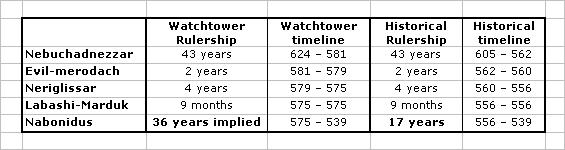
For the Watchtower timeline to be correct Nabonidus needs to have ruled for 36 years, yet the Society admits archaeology shows he only ruled for 17 years.
"Other investigators say this: "The Nabunaid Chronicle . . . states that Sippar fell to Persian forces VII/14/17* (Oct. 10, 539), that Babylon fell VII/16/17 (Oct. 12), and that Cyrus entered Babylon VIII/3/17 (Oct. 29). This fixes the end of Nabunaid's reign and the beginning of the reign of Cyrus.
[* Footnotes]"VII/14/17": The 7th Hebrew month Tishri, 14th day, 17th year of Nabonidus' reign." Watchtower 1968 Aug 15 p.491
"Last supreme monarch of the Babylonian Empire; father of Belshazzar. On the basis of cuneiform texts he is believed to have ruled some 17 years (556-539 B.C.E.). He was given to literature, art, and religion. Insight on the Scriptures, Vol 2 p.457 Nabonidus
There is a further problem created by the Watchtower timeline. The following quote goes on to say that there were two Nabonidus' due to tablets showing that Nabonidus was ruling over a city in the eighth year of Nebuchadnezzar. The reason the Watchtower Society has be forced to create an unattested second Nabonidus is due to their claim that Nebuchadnezzar started ruling in 624 B.C., making Nabonidus too young to rule at that time. However, since archaeology shows Nebuchadnezzar started ruling in 605 B.C. it is perfectly acceptable for Nabonidus to have been ruling a city in 597 B.C., and still been alive in 539 B.C.
"Cuneiform tablets of the eighth year of Nebuchadnezzar (Nisan 617-Nisan 616 B.C.E.) list a certain Nabu-na´id as the one "who is over the city," and some historians believe this is the same Nabonidus who later became king. However, this would mean that Nabonidus was a very young man when placed in such administrative position and would make him extremely aged at the fall of Babylon, some 77 years later (539 B.C.E.)." Insight on the Scriptures, Volume 2 p.457 Nabonidus
It is amazing that with Watchtower information it can be shown that 607 B.C. was not the year for the fall of Jerusalem. The Bible explains what happened during this period.
2 Kings 24 records that Jehoiakim paid tribute to Babylon for three years. The Babylonian record confirms that this was for the three years of 604, 603 and 602 B.C., with the tribute being collected in November/December. When it came time to collect the tribute in the next year, Egypt and Judah rebelled. The Babylonian record shows that beginning in November 601 B.C., Nebuchadnezzar fought a great war with Egypt, which he barely won, with both sides suffering heavy casualties. It was when Babylon was in this weakened state that Jehoiakim rebelled against Nebuchadnezzar, as discussed at 2 Kings 24:1-2;
"In his days Neb·u·chad·nez´zar the king of Babylon came up, and so Je·hoi´a·kim became his servant for three years. However, he turned back and rebelled against him. And Jehovah began to send against him marauder bands of Chal·de´ans and marauder bands of Syrians and marauder bands of Mo´ab·ites and marauder bands of the sons of Am´mon, and he kept sending them against Judah to destroy it, according to Jehovah's word that he had spoken by means of his servants the prophets."
As Nebuchadnezzar was personally at war in Egypt, his vassal kingdoms of Syro-Palestine were used to punish Jerusalem for Jehoiakim's rebellion. The destruction they inflicted upon Judah in November/December 601 B.C. was severe enough that it was said to have fulfilled the words of the prophets that Jerusalem would be destroyed. This was the first destruction of Jerusalem by Babylon. The well-known second and final destruction of Jerusalem by Babylon was over thirteen years later in 587 B.C.
601 B.C. could be used as the date of the destruction of Jerusalem, though generally the date of 587 B.C. is used as this is when it was totally destroyed. In either case 607 B.C. is unsupported. If the Society decided to use either of these dates then they would have to move the start of the Last Days to either 1920 or 1934.
Footnotes
Evidence for 587 BC
(1) Early historians, the Neo-Babylonian chronicles, and the Uruk kinglist
(2) Inscriptions Nabon. No.18 and Nabon. No. 8 (the Hillah stele)
(3) Nabon. H 1, B (the Adad-guppi’ stele)
(4) Economic-administrative and legal documents [numbering in the tens of thousands]
(5) Prosopographical evidence
(6) Chronological interlocking joints
(7) Synchronisms with the contemporary Egyptian chronology
(8) The Astronomical diary VAT 4956
(9) The astronomical diary B.M. 32312
(10) The Saturn tablet B.M. 76738+76813
(11) The lunar eclipse tablet LBAT 1417
(12) The lunar eclipse tablet LBAT 1419
(13) The lunar eclipse tablet LBAT 1420
(14) The lunar eclipse tablet LBAT 1421
(15) LBAT 1415
(16) Lunar eclipse Text no. 5 in Hunger, ADT V.
(17) Text no. 52 in Hunger, ADT V.
(18) Planetary tablet, SBTU IV 171
Recommended Links
The Gentile Times Reconsidered - Carl Jonsonn
Carl Jonsonn's Website
Carl's brilliant examination of the Watchtower 2011 October 1st and November 1st in PDF format, Part 1 and Part 2, shows the intellectual dishonesty of the Watchtower by including inaccurate information and misquotes.
For a detailed critique by Doug Mason, see the following articles.
Critique on Oct 1 2011 Watchtower. This is a 51 page, 7mb PDF file.
Critique on Nov 1 2011 Watchtower - Part A. This is a 6mb PDF file.
Critique on Nov 1 2011 Watchtower - Part B. This is a 7mb PDF file.

Ukrainian translation of this article.
Written 2007. Latest update November 2022.
 Paul Grundy 2005 - 2026