
home > questionable doctrine > pagan practices
Pagan Practices and Doctrine
Watchtower forbids Jehovah’s Witnesses from engaging in many common practices on the basis that the origin is pagan. On the other hand, they have also stated that having a pagan origin is not as important as the current view of that practice. This contradictory stand has led to numerous inconsistencies and changes.
Watchtower prevents Jehovah's Witnesses from engaging in a veritable list of practices by invoking the justification that these practices are of pagan origin. This reasoning is likewise extended to the rejection of doctrine. This is illogical, misused, and contradictory. Virtually everything is pagan. Pagans, (and exactly who is such a term supposedly referring to), have done everything we do. They eat, drink, copulate, and worship. For this reason, Watchtower uses it in wildly contradictory ways.
Whilst many doctrines and practices are forbidden based on having roots in pagan worship, Watchtower has said for decades that should not be of concern, undermining the times where it is used.
However, if one’s motive in putting up a wind chime has nothing to do with false religion, superstition or demonism, and there is little possibility of others’ getting the wrong impression regarding its use in the home, it is a simple matter for personal decision." Watchtower 1981 Jun 1 p.31
“A main concern is, not what the practice meant hundreds of years ago, but how it is viewed today in your area." Awake! 2003 Sep 22 p.24
Because paganism is an illogical line of reasoning, the Watchtower is inconsistent in its application of this principle. For instance, whilst Watchtower allows weddings, wedding rings, veils, white dresses and wedding cakes, it forbids throwing confetti, despite all having pagan connections.
Practices
Watchtower:
- prohibits many practices on the basis as being pagan
- has flip-flopped on some being forbidden and then allowed
- allows many practices with pagan connections
Presented as a list, it is clear there is no consistency in how Watchtower choses to evoke this concept.
Prohibited because Pagan
Wedding Practices - Confetti
"Since there are so many traditional practices, should a Christian try to avoid all the wedding customs of his area? Not necessarily. ... In many lands it is common to throw rice at the bride and groom. What is the point of the custom? Some peoples believe the rice is food to keep evil influences away from the bride and groom. Some say it assures the couple fertility." Watchtower 1969 Jan 15 p.58
Christmas
"What Does the Bible Say About Christmas?
... Instead, an examination of the history of Christmas exposes its roots in pagan religious rites." Bible Questions Answered - jw.org (as of Jan 2026)
"What caused the Bible Students to stop celebrating Christmas? Richard H. Barber gave this answer: "I was asked to give an hour talk over a [radio] hookup on the subject of Christmas. It was given December 12, 1928, and published in The Golden Age #241 and again a year later in #268. That talk pointed out the pagan origin of Christmas. After that, the brothers at Bethel never celebrated Christmas again." Yearbook 1975 p.147
Easter
"What Does the Bible Say About Easter?
... The American Book of Days well describes the origin of Easter: “There is no doubt that the Church in its early days adopted the old pagan customs and gave a Christian meaning to them.”" Bible Questions Answered - jw.org (as of Jan 2026)
Birthdays
"However, there is no indication in the Scriptures that faithful worshipers of Jehovah ever indulged in the pagan practice of annually celebrating birthdays." Insight on the Scriptures - Volume 2 p.319
"What about the birthday cake? It appears to be related to the Greek goddess Artemis, whose birthday was celebrated with moon-shaped honey cakes topped with candles." Mankind’s Search for God (1990) p.70
“The various customs with which people today celebrate their birthdays have a long history. Their origins lie in the realm of magic and religion. … Down to the fourth century Christianity rejected the birthday celebration as a pagan custom.” Reasoning from the Scriptures pp.68-70
"Is it proper to have or attend celebrations of birthday anniversaries?-F. K., Nevada. Such celebrations have their roots in pagan religions, and not Scriptural grounds. Some Bible commentators suggest that birthday celebrations may have had their origin in the "notion of the immortality of the soul"." Watchtower 1951 Oct 1 p.607
Flip-Flopped from Unacceptable to Acceptable
Calendar
The calendar is pagan, with the days of the week and months named after mythological Gods.
"The Devil, of course, was the one who induced the ancestors of the present generation to name all the days of the week after heathen gods and goddesses." Golden Age 1935 Mar 13 p.358
For this reason, Watchtower introduced the "Calendar of Jehovah God" (Golden Age 1935 Mar 13 p.380). Click here for the Golden Age 1935 Mar 13 - 7 Mb PDF.
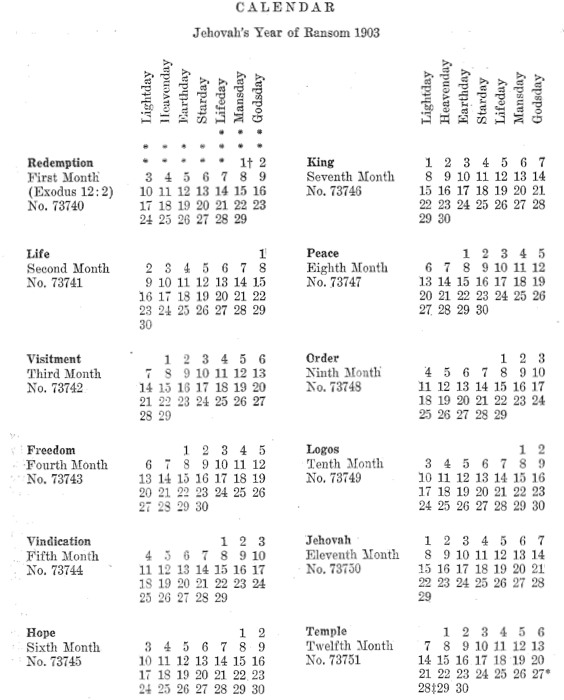
Proving impractical, this concept did not last, and Witnesses continue to use the pagan Gregorian calendar under the justification its' pagan origins are inconsequential and justified as part of subjection to “the superior authorities.”
"The present time divisions of hours, minutes and seconds are based on an early Babylonian system. Yet, there is no objection to a Christian's using these time divisions, for one's doing so does not involve carrying on false religious practices." Watchtower 1972 Jan 15 p.63
"The Gregorian calendar used today has months named after the gods Janus and Mars, and the goddess Juno, as well as for Julius and Augustus Caesar, yet it continues to be used by Christians who are subject to “the superior authorities.”—Ro 13:1." Insight on the Scriptures - Volume 2 p.1065
Pinjata
In 1971, piñatas were spoken against as pagan.
“Catholic teachers employed piñatas in giving the Indian natives religious instruction. ... Piñatas also came to be used in connection with Christmas. ... Nowadays the Posada in Mexico features disorder, drunkenness and criminal activity. The celebrations are used as an excuse for wild and immoral living. ... Today, however, many give little thought to the religious aspects of Posada and the breaking of the piñata. ...
But even though the use of the piñata is quite popular in some places, there are those who have serious misgivings about the false religious practices connected with it." Awake! 1971 Jun 22 pp.23-24
In 2003, it was explained a piñata is acceptable, as it is not the past but current views that determine its use.
"When considering whether to include a piñata at a social gathering, Christians should be sensitive to the consciences of others. (1 Corinthians 10:31-33) A main concern is, not what the practice meant hundreds of years ago, but how it is viewed today in your area. Understandably, opinions may vary from one place to another. Hence, it is wise to avoid turning such matters into big issues." Awake! 2003 Sep 22 pp.23-24
Toasting
Jehovah's Witnesses were not allowed to offer a toast or clink glasses until 2025.
"A common practice at weddings and on other social occasions is toasting. The 1995 International Handbook on Alcohol and Culture says: “Toasting . . . is probably a secular vestige of ancient sacrificial libations in which a sacred liquid was offered to the gods . . . in exchange for a wish, a prayer summarized in the words ‘long life!’ or ‘to your health!’” True, many people may not consciously view toasting as a religious or superstitious gesture. Still, the custom of lifting wine glasses heavenward might be viewed as a request to “heaven”—a superhuman force—for a blessing in a way that does not accord with that outlined in the Scriptures." “Keep Yourselves in God’s Love” (2008) chapter 13 Celebrations That Displease God
In 2025, toasting became acceptable.
"Therefore, after prayful consideration, the Governing Body has concluded that there is no need to make a rule regarding toasting and clinking glasses. Each Christian should use the principles that we have discussed in this update and his own Bible-trained conscience to make a good decision. What does this mean? Are we saying that toasting is OK now at all times and in every situation? Of course not. We are simply saying that there is no need to make a rule." 2025 Governing Body Update #4
This change outlines how Watchtower’s misuse of pagan origins has led to long held rules that never had a solid basis.
Pagan does not Matter
Watchtower undermines its own rejection of matters based on paganism when it makes comments that pagan roots are of lesser importance than current perception:
Wind Chimes
"Would it be wrong for a Christian to use wind chimes in his or her home?
Many persons have used wind chimes to give a pleasant musical aspect to the home. When the wind blows, the glass, metal or wooden pieces hit against one another to produce the sound. However, it is the custom in some countries to put up wind chimes with the thought that they will keep evil spirits from entering the home. Obviously, a Christian would not make use of wind chimes for such a purpose. So if there is such a superstitious belief in one’s country, or community, it would not be wise to have a wind chime in the home. Thus no one will be stumbled or given the impression that Jehovah’s Witnesses make use of wind chimes for some unscriptural purpose.—1 Cor. 10:31-33.
However, if one’s motive in putting up a wind chime has nothing to do with false religion, superstition or demonism, and there is little possibility of others’ getting the wrong impression regarding its use in the home, it is a simple matter for personal decision." Watchtower 1981 Jun 1 p.31
Wedding Rings
Watchtower admits wedding rings are pagan, but claims that is not important.
"Indicating the non-Christian origin of many of apostate Christendom’s doctrines, ceremonies, and practices, 19th-century Roman Catholic cardinal John Henry Newman wrote in his Essay on the Development of Christian Doctrine: “The use of temples, and these dedicated to particular saints, and ornamented on occasions with branches of trees; incense, lamps, and candles; votive offerings on recovery from illness; holy water; asylums; holydays and seasons, use of calendars, processions, blessings on the fields; sacerdotal vestments, the tonsure, the ring in marriage, turning to the East, images at a later date, perhaps the ecclesiastical chant, and the Kyrie Eleison [the song “Lord, Have Mercy”], are all of pagan origin, and sanctified by their adoption into the Church.”" Revelation, It's Grand Climax p.236
"Moreover, the wedding ring at one time had religious significance. Yet, most people today do not know that, considering a wedding ring a mere evidence that someone is married." Watchtower 2007 Feb 15 p.30
Pagan practices encompass an extensive list of common activities, including most of what a Jehovah’s Witness does in their day-to-day life. Witnesses are left with no alternative but to suggest that when pagans do what they want to do, it is of no consequence, but when they do what a Witness is disallowed, suddenly pagans are the reason we need to avoid it.
Other common activities tracing back to pagan roots are:
- The use of eye makeup is tied to false beliefs about evil spirits.
- Dressing the bride, bride’s maids and groom and his attendants in similar clothing.
- Cremating a body
When pagans did things that Watchtower allows for Jehovah’s Witnesses, it suggests it is of no consequence, but what pagans did that Watchtower does not want Jehovah’s Witnesses to engage it, connection to what people may have done thousands of years ago becomes reason to avoid it. Since Jehovah’s Witnesses are allowed to participate in many pagan practices, it becomes irrelevant what practices pagans engaged in. It is inconsistent to cherry-pick to forbid a practice because an earlier group of people engaged in it and rather consider the current reason for it.
Doctrine
Watchtower attempts to condemn some common Christian doctrine as wrong because it aligns with what some pagan religions believed.
"Thus the willingness to compromise that allowed the entry of pagan doctrines also allowed unchristian immorality, cruelty, oppression, and so forth. ... They also avoid the syncretism that occurred hundreds of years ago, which brought hellfire, the immortal soul, the Trinity, images, the cross and other pagan beliefs into Christendom’s system of worship." Awake! 1983 Aug 22 p.19
Watchtower condemns the concept that Jesus’ death on a “stauros” was a cross because other religions use a cross in worship, yet promote Jesus dying on a phallus shaped pole, something even more common in pagan worship.
The common Christian view that the nature of God is Triune is condemned as having pagan origins, as some other non-Chrisitan religions have a triune God, and is used as evidence against the Trinity. Yet many other religions do not believe in a Trinity.
In contradiction, Watchtower uses pagan teachings to support their own. The common pagan belief in God punishing people with by flood is used as evidence for the global flood of Noah being a literal event. In this case, they are not referred to as pagans, but primitive people.
"The fact that there are not merely a few but perhaps hundreds of different stories about that great Deluge, and that such stories are found among the traditions of many primitive races the world over, is a strong proof that all these people had a common origin and that their early forefathers shared that Flood experience in common." it-1Insight on the Scriptures - Volume 1 pp.609-612
Watchtower has even introduced doctrine that it had previously criticised as pagan. The removal and shunning of members was introduced in its current format in the 1950s, despite the 1947 Awake! explaining the pagan origins of this practice.
"The Encyclopaedia Britannica says that papal excommunication is not without pagan influence, "and its variations cannot be adequately explained unless account be taken of several non-Christian analogues of excommunication." The superstitious Greeks believed that when an excommunicated person died the Devil entered the body, and therefore, "in order to prevent it, the relatives of the deceased cut his body in pieces and boil them in wine." Even the Druids had a method of expelling those who lost faith in their religious superstitions. It was therefore after Catholicism adopted its pagan practices, A.D. 325, that this new chapter in religious excommunication was written." Awake! 1947 Jan 8 p.27
Virtually every belief can be aligned with a pagan or “primitive” religious counterpart, so it does not follow that a doctrine is wrong because of such a connection.
Watchtower has claimed for decades that pagan origins are not what matters, but how a practice is viewed in the community – when allowing a practice. But continues to use this concept to forbid behaviour that no longer has any connection to ancient customs. It is apparent from this inconsistent application that Watchtower uses the “Pagan” concept to support a preconceived agenda, rather than there being any logic behind when it condemns a practice or belief as pagan.
Footnote
Denied based on Paganism
• Christmas
• Easter
• Lent
• Carnival
• Olympics
• New Year’s Eve
• Valentine’s Day
• Mother´s Day
• Father´s Day
• Day of the Dead
• Halloween
• Birthdays
• Throwing Rice
• Throwing the Bouquet
• Wedding Marches
• Astrology
• Rosary
• Symbols on graves such as fish, anchor and dove, peacock
• Star of David
• Democracy
• Lantern Festival
• Mazes and Labyrinths
• Cross
• Hell
• Immortality of the Soul
• Clerical Celibacy
• Trinity
• Mary the Mother of God
• Philosophy
• Harvest Festival
• Saying “Bless you”
• May Day
• Offering Incense to the dead
• Bowing to a picture of a deceased one
• Throwing Soil into a grave
• Throwing flowers into a grave
• Drawing Halos on religious figures
Acceptable despite Pagan origins
• Veil on bride
• Bridesmaids same color, or even white
• Wedding Ring
• Wedding cake
• Calendars
• Piñatas
• The Twist
• Using Flowers in a funeral
• Removing or Disfellowshipping
• Toasting
Written January 2026.
 Paul Grundy 2005 - 2026