
home > questionable doctrine > 607 : 1914 : seven times
607 : 1914 : Seven Times
Daniel's prophecy of the Seven Times is key to the existence of Jehovah's Witnesses. This is used the determine that Jesus started ruling in 1914 and subsequently chose the Watchtower organization in 1919 to be his sole means of salvation.
This article covers five key areas, proving Daniel 4 does not indicate Jesus started ruling in 1914:
- Daniel 4 is not an end time prophecy
- Jerusalem did not fall in 607 B.C.
- When the 70 years were
- Watchtower interpretative methodology is inconsistent
- Watchtower Seven Times interpretation was taken from 19th century Second Adventist preachers
Daniel 4 - no Second Fulfilment
Each prophecy in Daniel had only one fulfilment, yet the Watchtower claims Daniel 4:9-32 should have two fulfillments.
Daniel 4:9-32 "'O Bel·te·shaz´zar the chief of the magic-practicing priests, because I myself well know that the spirit of the holy gods is in you and that there is no secret at all that is troubling you, tell [me] the visions of my dream that I have beheld and its interpretation. 10"'Now the visions of my head upon my bed I happened to be beholding, and, look! a tree in the midst of the earth, the height of which was immense. more...
- Daniel 2: An immense image representing kingdoms
- Daniel 4: Seven times representing Nebuchadnezzar - (AND 1914?)
- Daniel 5: Writing on the wall foretelling Babylon's immediate destruction
- Daniel 7: Four beasts being 4 world powers
- Daniel 9: Seventy weeks foreshadowing Christ's arrival
- Daniel 11: Kings of the North and South
Why attempt to impose upon Daniel 4 a second fulfilment, when all other Daniel prophecies had but one fulfilment?
Daniel 4 shows the prediction that Nebuchadnezzar would act as a beast for 7 years. It takes significant imagination to deduce Daniel 4 points to our time. There is no reference to a second fulfilment, no reference to Gentile times, no reference to the Last Days and no reference to the Israelites. Despite this, the prophecy of the seven times is the lynch pin of the Watchtower belief structure as it is the only Scripture used to indicate that Jesus started ruling specifically in the year 1914.
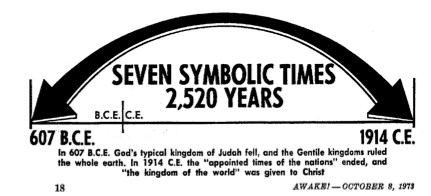
The current Watchtower understanding is that this prophecy signifies the end of God's rulership through the Jews in 607 B.C. The next 2,520 years were the Gentile Times of the Nations, until God re-established his Kingdom in heaven in 1914.
The interpretation goes as follows;
- The cutting down of the tree represents the destruction of the Kingdom of Judah by Nebuchadnezzar in 607 B.C.
- The "seven times" constitute 2,520 days, 7 years of only 360 days each
- The principle of "a day for a year" converts 2,520 days to 2,520 years
- The 2,520 years of the Gentile times ended in 1914, coinciding with the start of Jesus' heavenly rulership
Even if Daniel 4 was to have a secondary fulfilment, each point is based on misconceptions that are discussed in detail throughout this article.
607 B.C. Inaccurate
Since its 15th April 1964 edition, the Watchtower uses the interchangeable abbreviations B.C.E. and C.E. in place of B.C. and A.D. The term Common Era traces back to 1615, and the abbreviation C.E. to the mid-19th century. B.C.E/C.E are becoming more common since the late twentieth century out of sensitivity to non-Christians.
Jerusalem fell between 586 and 587 B.C. This is stated in virtually all encyclopaedias and supported by a vast volume of historical information. The Watchtower claims this figure is wrong and that Jerusalem was destroyed in 607 B.C.E. This is highly significant for Jehovah's Witnesses, as if Jerusalem was not destroyed in 607 B.C., then Jesus rulership did not commence in 1914, nor was the Watchtower Society chosen by him in 1919.
There is a large weight of evidence that can be used to prove 607 B.C. wrong. As early as 1929, Raymond Philip Dougherty's Nabonidus and Belshazzar, Yale University Press, page 10 showed that the knowledge of the reign of these kings "is based upon more than two thousand dated cuneiform documents. It must therefore be accepted as the ultimate criterion in the determination of Neo-Babylonian chronological questions."
There are numerous ways used to determine that Jerusalem fell in 587 B.C. This includes Ptolemy's Canon, the Nabonidus Chronicle, Harran, Hillah stele and synchronization with Egyptian chronology. The Dictionary of Biblical Archaeology, page 274 states "Archaeological evidence for the destruction of the kingdom in 586 B.C. comes from Jerusalem, Lachish, Tell Beit Mirsim, and other sites." Tens of thousands of detailed Economic-administrative and legal documents have been unearthed outlining daily, monthly and yearly occurrences during the reign of the Babylonian kings.
Prosopography is the study of careers and makes the Watchtowers addition of twenty years to Babylonian history unlikely due to the extending the life span of discovered Babylonians. A comparison of business people such as the Egibi business house with Watchtower chronology would require people mentioned in these records to have been working to over the age of 100. Likewise the Adad-guppi' stele would require the mother of Nabonidus to have lived until the age of 121.
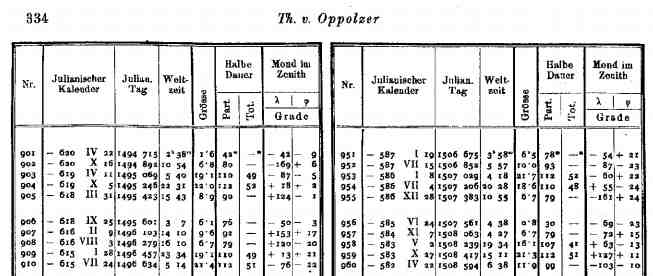
The highly predicable nature of the stars and planets makes astronomical observations invaluable in dating prior events. Babylonians placed great importance on astrology and the thousands of records uncovered prove precisely the dates for the reign of Babylonian kings. VAT 4956 provides 30 observations, 5 of which place Nebuchadnezzar's 37th year as 568/67 B.C.E., making this an absolute date. This is significant as 2 Kings 25:2,8 places "the eleventh year of King Zedekiah" in "the nineteenth year of King Nebuchadnezzar", proving beyond doubt the date for the fall of Jerusalem.
For detailed evidence from Assyrian and Babylonian records proving the fall of Jerusalem was in 587 B.C., see the book The Gentile Times Reconsidered

Watchtower Refute

Click on the image for a 22 page PDF that shows the Watchtower depends on the same astronomical tablets to arrive at 607 that it says are unreliable for arriving at 587.
The Watchtower claims that the above evidence is meaningless, wrong and cannot be trusted, because it disagrees with Bible prophecy, (or more accurately Watchtower interpretation of Bible prophecy).
"If we follow the accurate timekeeping of Jehovah God as recorded in his Word, we see that the desolation of Judah ran from 607 to 537 B.C.E. and will thereby avoid making the mistake of the chronologers of Christendom who ignore the prophecy of the seventy years' desolation and date Jerusalem's destruction as occurring in 587 B.C.E. They limit the desolation of Jerusalem and the land of Judah to merely fifty years, accepting the unreliable calculations of pagan historians rather than the infallible Word of God." Watchtower 1965 Sep 15 p.569
"However, where the interpretation of these findings conflicts with clear statements in the Bible, we accept with confidence what the Holy Scriptures say, whether on matters related to chronology or any other topic." Watchtower 1989 Mar 15 p.22
This argumentation is both baseless and counter productive, as the Watchtower relies on the very same historical records to arrive at 607 B.C. Archaeological evidence that shows the destruction of Jerusalem was in 587 B.C. is the same evidence that the Society accepts as proof that 539 B.C. was the destruction of Babylon. The Watchtower determines 607 B.C. as the destruction of Jerusalem by accepting the historical records used to calculate when Babylon fell, and then working back 70 years from there. Archaeologists that prove when Babylon fell are the same people that have proven Jerusalem fell in 587 B.C. (Furthermore, the claim that 587 B.C. conflicts with Bible prophecy is not a relevant argument, as there are historically acceptable ways to reconcile the prophecy, as will be shown later.)
For example, to arrive at 539 B.C. for Babylon’s fall, Insight on the Scriptures relies upon an astronomical tablet and the work of scholars Strassmaier, Kugler, Oppolzer and Gingerich, to determine that King Cambyses’ 7th regnal year was 523/522 B.C.
"A Babylonian clay tablet is helpful for connecting Babylonian chronology with Biblical chronology. This tablet contains the following astronomical information for the seventh year of Cambyses II son of Cyrus II: … (Inschriften von Cambyses, König von Babylon, by J. N. Strassmaier, Leipzig, 1890, No. 400, lines 45-48; Sternkunde und Sterndienst in Babel , by F. X. Kugler, Münster, 1907, Vol. I, pp. 70, 71). … Thus, this tablet establishes the seventh year of Cambyses II as beginning in the spring of 523 BCE. This is an astronomically confirmed date." Insight on the Scriptures p.453
After accepting the date calculated for the astronomical tablet from Cambyses’ 7th year, Insight then relies on the secular chronology, such as provided by Ptolemy’s Canon, to travel to the date of Babylon’s 539 B.C. fall.
"The date of 539 B.C.E. for the fall of Babylon can be arrived at not only by Ptolemy's canon." Insight on the Scriptures p.454
It is because of the extreme reliability of the information regarding the secular king lists that the Watchtower is able to depend on 539 B.C. as the fall of Babylon, upon which it applies simple maths to determine 607 B.C. as the fall of Jerusalem. Despite absolute dependance on these sources for determining 607 B.C., the Watchtower claims they are unreliable and should not be used to calculate the fall of Jerusalem.
"Though the classical historians and the canon of Ptolemy disagree with this date [607 B.C.], valid questions can be raised about the accuracy of their writings." Watchtower 2011 Oct 1 p.31
The Watchtower has no proof to support 607 B.C. as Jerusalem's fall, other than its esoteric Biblical interpretation. Even then it must rely on historians to calculate back to that date. Nor are they able to logically counter the volumes of information that show Jerusalem fell in 587 B.C. So when it then is required to undermine these very historians it puts itself in a contradictory position that undermines any credibility in 607 B.C. For a prophecy of such importance to the Watchtower, the onus of proof is upon them to provide legitimate support to this teaching. Yet because it is wrong, they necessarily put themselves in a position that makes it impossible to do so.
Calculating 587 B.C. from the Watchtower
There is a large weight of evidence that can be used to prove this year wrong. As early as 1929, Raymond Philip Dougherty's Nabonidus and Belshazzar, Yale University Press p.10 showed that the knowledge of the reign of these kings "is based upon more than two thousand dated cuneiform documents. It must therefore be accepted as the ultimate criterion in the determination of Neo-Babylonian chronological questions." Not surprisingly, since the Watchtower relies on historical evidence to prove when Babylon fell, information presented in the Watchtower's own journals can be used to show that 607 B.C. is wrong.
Following is a simple calculation of when Jerusalem fell, taken solely from Watchtower literature. In viewing the calculation, remember that everything goes backwards when calculating years B.C.
| Babylon fell | "Babylon fell in 539 B.C." Babylon the Great Has Fallen - God's Kingdom Rules p.184 | 539 B.C. |
| Plus Nabonidus | "On the basis of cuneiform texts he is believed to have ruled some seventeen years(556-539 B.C.E.)." Aid to Bible Understanding - Nabonidus p.1195 | 17 years |
| Plus Labashi-Marduk | "Labashi-Marduk ... was a vicious boy, and within nine months he had his throat cut by an assassin." Babylon the Great Has Fallen - God's Kingdom Rules p.184 | 1 year |
| Plus Neriglissar | Neriglissar ... reigned four years Babylon the Great Has Fallen - God's Kingdom Rules p.184 | 4 years |
| Plus Evil-Merodach | "After reigning but two years King Evil-Merodach was murdered" Babylon the Great Has Fallen - God's Kingdom Rules p.184 | 2 years |
| Plus Nebuchadnezzar | "Nebuchadnezzar ruled as king for 43 years" Insight on the Scriptures, Volume 2 p.480 | 43 years |
| Equals start of Nebuchadnezzar's reign | Calculated by adding above figures | 606 B.C. |
| Minus Nebuchadnezzar's 19th year | 2 Kings 25:8-9 "And in the ... nineteenth year of King Neb·u·chad·nez´zar ... the servant of the king of Babylon, came to Jerusalem. And he proceeded to burn the house of Jehovah" | 19th year |
| Date for Destruction | Therefore calculated as: | 587 B.C. |
Watchtower publications can be used to show that the date of the destruction is 587 B.C. simply by adding the length of reigns of the Babylonian kings that they have given.
-
"Amel-Marduk (Evil-merodach) as the oldest son succeeded Nebuchadnezzar to the throne in 581 B.C.E. He did a kindness to one of the Judean captives, by which kindness he unwittingly carried out Jehovah's purpose. Second Kings 25:27-30 states: "It came about in the thirty-seventh year of the exile of Jehoiachin the king of Judah, in the
twelfth month [in 580 B.C.E.], . . . Evil-merodach the king of Babylon, in the year of his becoming king, raised up the head
of Jehoiachin the king of Judah out of the house of detention; and he began to speak good things with him, and then put his
throne higher than the thrones of the kings that were with him in Babylon. And he took off his prison garments; and he ate
bread constantly before him all the days of his life." Jehoiachin (or Jeconiah) had seven sons in Babylonia,
including Shealtiel, whose nominal son Zerubbabel became governor of rebuilt Jerusalem, and through whose
line of descent Jesus Christ came.-1 Chron. 3:17-19; Hag. 1:1; 2:23; Ezra 5:1, 2; Matt. 1:12.
Evil-merodach reigned two years and was murdered by his brother-in-law Neriglissar, who reigned for four years,
which time he spent mainly in building operations. His underage son Labashi-Marduk, a vicious boy, succeeded him,
and was assassinated within nine months. Nabonidus, who had served as governor of Babylon and who had been
Nebuchadnezzar's favorite son-in-law, took the throne and had a fairly glorious reign until Babylon fell in 539 B.C.E." Watchtower 1965 January 1 p.29
This article shows that the Watchtower accepts the scholarly view of the Babylonian line of kings. Nebuchadnezzar was succeeded by:
- Evil-merodach 2 years
- Neriglissar 4 years
- Labashi-Marduk 9 months
- Nabonidus until 539 B.C.
Where the Watchtower differs with history is that it says Nebuchadnezzar gave up the throne in 581 B.C. History shows it was in 562 B.C. Therefore the two timelines are:
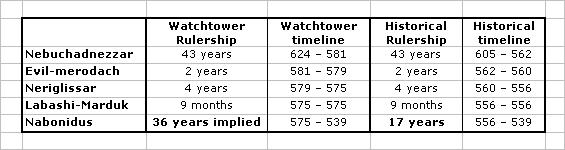
For the Watchtower timeline to be correct Nabonidus needs to have ruled for 36 years, yet the Society admits archaeology shows he only ruled for 17 years.
"Other investigators say this: "The Nabunaid Chronicle . . . states that Sippar fell to Persian forces VII/14/17 [Footnotes]"VII/14/17": The 7th Hebrew month Tishri, 14th day, 17th year of Nabonidus' reign. (Oct. 10, 539), that Babylon fell VII/16/17 (Oct. 12), and that Cyrus entered Babylon VIII/3/17 (Oct. 29). This fixes the end of Nabunaid's reign and the beginning of the reign of Cyrus." Watchtower 1968 Aug 15 p. 491
"Last supreme monarch of the Babylonian Empire; father of Belshazzar. On the basis of cuneiform texts he is believed to have ruled some 17 years (556-539 B.C.E.). He was given to literature, art, and religion. Insight on the Scriptures, Volume 2 p.457 Nabonidus
There is a further problem created by the Watchtower timeline. The following quote goes on to say that there were two Nabonidus' due to tablets showing that Nabonidus was ruling over a city in the eighth year of Nebuchadnezzar. The reason the Watchtower Society has be forced to create an unattested second Nabonidus is due to their claim that Nebuchadnezzar started ruling in 624 B.C., making Nabonidus too young to rule at that time. However, since archaeology shows Nebuchadnezzar started ruling in 605 B.C. it is perfectly acceptable for Nabonidus to have been ruling a city in 597 B.C., and still been alive in 539 B.C.
"Cuneiform tablets of the eighth year of Nebuchadnezzar (Nisan 617-Nisan 616 B.C.E.) list a certain Nabu-na´id as the one "who is over the city," and some historians believe this is the same Nabonidus who later became king. However, this would mean that Nabonidus was a very young man when placed in such administrative position and would make him extremely aged at the fall of Babylon, some 77 years later (539 B.C.E.)." Insight on the Scriptures, Volume 2 p.457 Nabonidus
It is amazing that with Watchtower information it can be shown that 607 B.C. was not the year for the fall of Jerusalem. The Bible explains what happened during this period.
2 Kings 24 records that Jehoiakim paid tribute to Babylon for three years. The Babylonian record confirms that this was for the three years of 604, 603 and 602 B.C., with the tribute being collected in November/December. When it came time to collect the tribute in the next year, Egypt and Judah rebelled. The Babylonian record shows that beginning in November 601 B.C., Nebuchadnezzar fought a great war with Egypt, which he barely won, with both sides suffering heavy casualties. It was when Babylon was in this weakened state that Jehoiakim rebelled against Nebuchadnezzar, as discussed at 2 Kings 24:1-2;
"In his days Neb·u·chad·nez´zar the king of Babylon came up, and so Je·hoi´a·kim became his servant for three years. However, he turned back and rebelled against him. And Jehovah began to send against him marauder bands of Chal·de´ans and marauder bands of Syrians and marauder bands of Mo´ab·ites and marauder bands of the sons of Am´mon, and he kept sending them against Judah to destroy it, according to Jehovah's word that he had spoken by means of his servants the prophets."
As Nebuchadnezzar was personally at war in Egypt, his vassal kingdoms of Syro-Palestine were used to punish Jerusalem for Jehoiakim's rebellion. The destruction they inflicted upon Judah in November/December 601 B.C. was severe enough that it was said to have fulfilled the words of the prophets that Jerusalem would be destroyed. This was the first destruction of Jerusalem by Babylon. The well-known second and final destruction of Jerusalem by Babylon was over thirteen years later in 587 B.C.
601 B.C. could be used as the date of the destruction of Jerusalem, though generally the date of 587 B.C. is used as this is when it was totally destroyed. In either case 607 B.C. is unsupported. If the Society decided to use either of these dates then they would have to move the start of the Last Days to either 1920 or 1934.
What were the 70 years?
It is recommended to read several Bible translations to understand the meaning of the following passages, as the New World Translation uses inflections to support their specific understanding.
The Watchtower claims Bible prophecy would be compromised if Jerusalem did not fall in 607 B.C. This is not the case at all and other Christians are able to reconcile the 70 year period within the historically accurate timeframe of 587 B.C. As there is no reason to believe Daniel 4 has two fulfillments, the precise start and end of the seventy year period is not of particular importance to most people. However, for the sake of Watchtower followers, it is good to understand how this period can be reconciled whilst remaining faithful to Bible statements.
Several Bible authors refer to a 70 year period, and close reading shows the possibility of more than one 70 year period. The 70 years can be seen within the concept of a Jewish timeframe or a Babylonian one. This section presents three ways in which the 70 years can be reconciled.
Babylonian timeframe

Click on the image for a 22 page PDF providing detailed explanation of when the 70 years started and ended.
The 70 years can be viewed from a Babylonian perspective, including their domination of the nations. Jeremiah 25 applies a 70 year period to both the surrounding nations and Jerusalem.
Jeremiah 25:11-12 "And all this land must become a devastated place, an object of astonishment, and these nations will have to serve the king of Babylon seventy years.'And it must occur that when seventy years have been fulfilled I shall call to account against the king of Babylon and against that nation,' is the utterance of Jehovah, 'their error, even against the land of the Chal·de´ans, and I will make it desolate wastes to time indefinite.'"
This shows the 70 years were the entire period the Babylonians were conquering "these nations", and the period of vassalage to the Babylonians. Jeremiah 25 ends the 70 years with the "account against the King of Babylon". The Babylonians dominated for a seventy year period from their defeat of Assyria in 609 B.C., to their fall in 539 B.C.
Jeremiah 29:10 concurs with this. In a number of translations, this verse links the completion of the 70 years with Babylon.
"This is what the LORD says: "When seventy years are completed for Babylon, I will come to you and fulfill my gracious promise to bring you back to this place." New International Version - see also ESV, NASB, RSV, ASV and DBY.
Jewish timeframe
The 70 years can be viewed within the concept of a Jewish timeframe. Zechariah 1:12, Zechariah 7:4-5, 2 Chronicles 36:20-23 and Daniel 9:2 all refer to 70 year periods.
Daniel 9:2 "In the first year of his reigning I myself, Daniel, discerned by the books the number of the years concerning which the word of Jehovah had occurred to Jeremiah the prophet, for fulfilling the devastations of Jerusalem, [namely,] seventy years."
Daniel may be indicating the period from the first destruction of Jerusalem in 601 B.C.
In the New World Translation, Jeremiah 29:10 refers to Israelites spending 70 years at Babylon. Reading from verse 1 indicates this includes the time period when the Israelites were taken to Babylon prior to the destruction of Jerusalem. Historians conclude this occurred in the year 605 B.C. when Daniel and his companions were taken.
Alternately, 70 years was the length of time the temple was in a state of disrepair, from the start of the siege on Jerusalem in 589 B.C. to the completion of the new temple in 519 B.C.
Whatever the case these, none of these periods point to 607 B.C. and yet Bible prophecy can continue to hold true, whilst accepting well supported secular history. Considering Daniel 4 is not an end time prophecy, there is no relevance to the precise start and end dates of the 70 years.
Figurative timeframe
| The Watchtower claims that the 70 year period of Tyre's desolation was figurative, but the 70 year period of Jerusalem's desolation had to be literal. |
In its Hebrew connotation, the number 70 can be used to represent completeness or universality. It is not necessary for the 70 years of devastation to be a literal period of time. Consider the enlightening piece of Watchtower reasoning for why the 70 year desolation of Tyre was not literal.
"Isaiah goes on to prophesy: "It must occur in that day that Tyre must be forgotten seventy years, the same as the days of one king." (Isaiah 23:15a) He says: "These nations will have to serve the king of Babylon seventy years." (Jeremiah 25:8-17, 22, 27) True, the island-city of Tyre is not subject to Babylon for a full 70 years, since the Babylonian Empire falls in 539 B.C.E. Evidently, the 70 years represents the period of Babylonia's greatest domination-when the Babylonian royal dynasty boasts of having lifted its throne even above "the stars of God." Isaiah's Prophecy- Light For All Mankind 1 p. 253
There is no reason that this same reasoning could not be applied to Jerusalem. If the seventy years of Tyre was not a literal 70 years, then the 70 years for Jerusalem does not need to be taken literally. The bona fide reason the Watchtower rejects 587 B.C. is purely that it undermines their basis for 1914.
Inconsistent Watchtower Methodology
There are a number of issues and inconsistencies with how the Watchtower determines that the seven times end in 1914.
606 B.C. or 607 B.C.
Russell believed the end of the seventy years was in 536 B.C., and hence counted back 70 years to 606 B.C. as the destruction of Jerusalem and start of the Seven Times. Under the rulership of Rutherford, it continued to be stated that Jerusalem fell in 606 B.C.
"THE SEVENTY YEARS OF DESOLATION This brings us to the period of the desolation of the land, which lasted seventy years, and was ended by the restoration of its people from Babylon, in the first year of Cyrus, B.C. 536 ..." Studies In the Scriptures Series II - The Time Is at Hand p.51
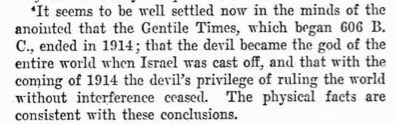
"It seems to be well settled now in the minds of the anointed that the Gentile Times, which began in 606 B.C., ended in 1914: ..." Watchtower 1925 Mar 1 p.67
In the 1940's, the Watchtower Society admitted its calculations for the 2,520 were inaccurate, incorrectly factoring in a year zero between B.C. and A.D.. Rectification meant that the Gentile Times started in 1915. With so much vested interest in 1914, the Watchtower leaders decided to simultaneously change the year they claimed Jerusalem fell from 606 B.C. to 607 B.C., and hence retain 1914. This required ending the seventy years in 537 B.C., instead of 536 B.C.
"Providentially, those Bible Students had not realized that there is no zero year between "B.C." and "A.D." Later, when research made it necessary to adjust B.C. 606 to 607 B.C.E., the zero year was also eliminated, so that the prediction held good at "A.D. 1914."-See "The Truth Shall Make You Free," published by the Watch Tower Society in 1943, page 239." Revelation - Its Grand Climax at Hand! p.105
Such an arbitrary move from 606 B.C. to 607 B.C. is only possible because the Watchtower does not deem it necessary to substantiate either year with historical proof.
The difficulty with this move was that by the 1940's historians had proven that Babylon fell in 539 B.C.
539 B.C. or 537 B.C.
The Watchtower Society concurs that 539 B.C. is a pivotal year historically. However, when it changed the fall of Babylon from 536 B.C. to 539 B.C. it only moved the end of the 70 year period back to 537 B.C. To retain 1914, it concocted an explanation that the 70 years end with the time the Jews arrived back in their homeland.
"There is strong evidence - and most scholars agree - that the Jewish exiles were back in their homeland by 537 B.C.E." Watchtower 2011 Oct 1 p.31
There are two problems with this statement. Firstly, it is not known when the Jews first arrived back in their homeland. Secondly, and more importantly, the 70 years did not end at that time, but rather at the destruction of Babylon in 539 B.C. Jeremiah 25:12 states the seventy years were fulfilled when Babylon is destroyed, not in an estimated year for the Jewish homecoming.
Jeremiah 25:12 "'And it must occur that when seventy years have been fulfilled I shall call to account against the king of Babylon and against that nation,' is the utterance of Jehovah, 'their error, even against the land of the Chal·de´ans, and I will make it desolate wastes to time indefinite."
Josephus
Josephus is in agreement with archaeological sources and can be used to show the Jewish destruction was in 587 B.C. He states that Jerusalem was desolate for only 50 years in Against Apion Book I, Chapter 21:
"Nebuchadnezzar, in the eighteenth year of his reign, laid our temple desolate, and so it lay in that state of obscurity for fifty years; but that in the second year of the reign of Cyrus its foundations were laid, and it was finished again in the second year of Darius,"
Surprisingly the Watchtower tries to use Josephus to prove Jerusalem was destroyed in 607 B.C. In the Appendix of the Watchtower publication, Let Your Kingdom Come it quotes Josephus' Antiquities of the Jews Book XI , Chapter 1 (though the quote is actually from Book X):
"all Judea and Jerusalem, and the temple, continued to be a desert for seventy years,"
and Josephus Against Apion Book I, Chapter 19:
"our city was desolate during the interval of seventy years, until the days of Cyrus" (italics theirs).
By emphasising the word desolate the Watchtower Society hides the meaning of the sentence. If the emphasis is shifted to the word
during, it shows Josephus may have meant the city was desolate for only part of that period.
The Watchtower reasoning makes Josephus works contradictory. There is no contradiction when understanding these passages to mean that Jerusalem was
desolate for a period of 50 years during the 70 year desolation of the nations. This then agrees with Bible prophecy, with the explanation of the 70 years above and also with history.
July or October
Many Jehovah's Witnesses believe that the start of World War One marked the end of the Gentile times and the start of the Last Days. After being cast from heaven Satan set about creating 'woe for the earth' by starting the War, a clear indication he was now confined to the earth. This is incorrect.
The Watchtower teaches that Jesus started ruling October 2 1914.
"That was a highly interesting time because a few of us seriously thought we were going to heaven during the first week of that October." Yearbook 1975 p.72
However, World War One began two months prior to this, generally considered to have been July 28. The start of World War One therefore cannot be used by Jehovah's Witnesses as a sign of Jesus "presence", as it began prior to the Last Days.
In my pioneer school it was explained that World War One was Satan's 'smoke screen' to divert attention from Jesus coming Kingdom. This does not make sense as Jesus kingdom is presently invisible. There was nothing happening on earth to that required "smoke screening". Neither does this reasoning have Scriptural backing, as Revelation says there would be woe for the earth and for the sea after Satan is cast down, not beforehand.
70 Weeks and the 7 Times
The 70 Weeks is a prophecy of Daniel used to indicate the time Jesus was to start his ministry. Some Witnesses have expressed to me they trust the interpretation of the Seven Times because it is determined using same methodology as Daniel's prophecy of the 70 Weeks.
This reasoning is without substance, as the calculation of the two prophecies varies considerably. The commonality between the two is that both use the formula of replacing a day for a year. After that the methodologies part ways.
Unique Interpretation: The Watchtower accepts the Christian understanding that the 70 Weeks pointed to Jesus. On the other hand, the Watchtower interpretation of the Seven Times is only adhered to by a small number of sects that trace their roots back to the 1800's Adventist movement.
Unique Secondary Fulfilment: The Watchtower agrees that the prophecy of the Seventy Weeks has only one fulfilment - the coming of the Messiah - whereas it claims the Seven Times should have two applications. The seven times clearly was fulfilled with the 7 year madness of King Nebuchadnezzar, the Watchtower is one of few religions that attempt to apply a secondary meaning to it.
Inconsistent Time Frame: The length of seventy weeks is easily calculated as being 490 days, and then a 'day for a year' is applied to extend it to 490 years. The seven times is not calculated in this method. By cross referencing to other scriptures a 'time' is said to represent a lunar 360 day year. The Watchtower inconsistently chooses when to apply a 360 day year or a 365 day year depending on the outcome they wish to achieve. (see Revelation and Daniel Prophecy.) In the seven times a lunar calendar is used to arrive at 2520 years, but then this is applied to a solar calendar to arrive at 1914.
Unverifiable: Jesus was visibly present at the time indicated by the prophecy of the 70 weeks and so the fulfilment is verifiable. The fulfilment of the 7 times is now said to have occurred invisibly, and as such was unnoticed by anyone other than the followers of Russell's teachings and unverifiable even by them.
Lunar Day for a Solar Year
The principle of "a day for a year" was used regularly by Russell but is only occasionally adhered to in Rutherford's prophetic calculations. For instance, the Daniel prophecies of 1260, 1290 and 1355 days are all currently said to signify a day for a day, not a day for a year. Previously, Russell had interpreted these same prophecies with the concept of a day for a year, with results completely unrelated to current interpretation.
The 2,520 years are calculated by using a 360 day "prophetic calendar", supported by comparing a "time" from Daniel with Revelation. However, the Watchtower then applies the 2,520 years determined from a 360 day year to a 365.2425 day solar calendar to arrive at 1914. This is 2,556 "prophetic years". The Gregorian solar calendar the Watchtower depends upon for its calculations was not introduced until 1582.
Some scholars prefer consistent use of a "prophetic" calendar and convert 2,520 lunar years to 907,200 days. 907,200 days from 607 B.C. ended in 1878 A.D., a significant Adventist year.
It does not necessarily follow that a "prophetic year" is 360 days, as this is not a term found in the Bible, but a later product of Biblical interpretation. A lunar year is 354.37 days (12 x 29.53 days). Most ancient calendars based on the moon are lunisolar, as intercalary additions are required to stop them wandering across seasons. Ancient Judea had two different calendars, a 354-day lunisolar calendar that is still in use today as the traditional Hebrew calendar, and a 364-day schematic priestly calendar used by Enochic and Essene Judaism. The schematic calendar is considered sabbatical as 364 days is divisible by 7. To arrive at a 360 day year requires using a 364 day year and removing the four epagomenal days; the two solstices and the two equinoxes.
History of the prophecy
Holy Spirit did not reveal an understanding of the seven times to Pastor Russell. It was promoted throughout the 1800's prior to Russell by John Aquila Brown, William Miller, E. B. Elliott, Robert Seeley, Joseph Seiss and Barbour.
In 1823, John Aquila Brown published in The Even-Tide that the "seven times" of Daniel 4 were prophetic of 2,520 years, running from the beginning of Nebuchadnezzar's reign in 604 B.C. to 1917 A.D. He did not equate this to the end of the Gentile Times.
In the 1830's, a farmer named William Miller explained that a number of prophecies were to conclude in 1843, and so came to the conclusion that Daniel 4 was also to end in 1843. To do so, he claimed the seven times started when Manasseh was taken as a captive to Babylon in 677 B.C. This was to signify the 'time of the end', the destruction of Babylon and when the dead would be raised. Apollos Hale and Sylvester Bliss corrected this date by removing the year zero that Miller had used in the calculation, promoting the time of the end to the year 1844. At Miller's suggestion, Samuel Snow calculated that the end would arrive on October 22. This was to correspond with the tenth day of the seventh Jewish month, the Day of Atonement for the year 1844. Rather than using the current Jewish calendar he used an older calendar invented by the Karaite Jews. Jehovah's Witnesses still use the Karaite calendar in their calculations, including for the date of the memorial.
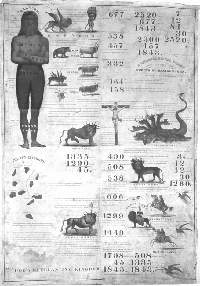
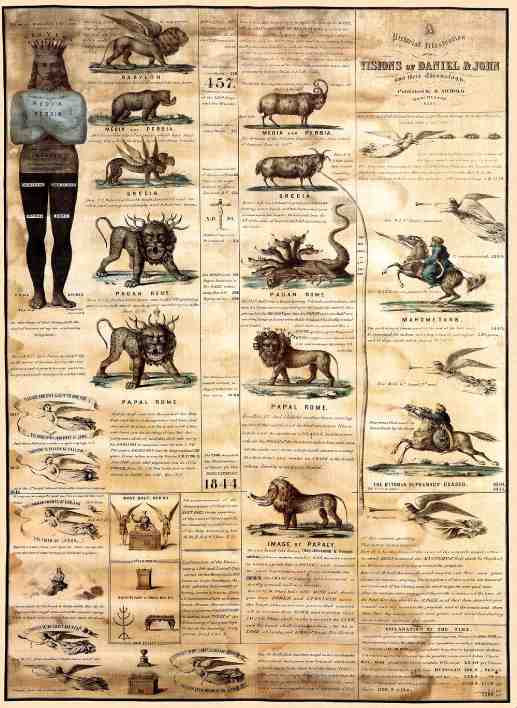
Millers Chart - Click on images to enlarge
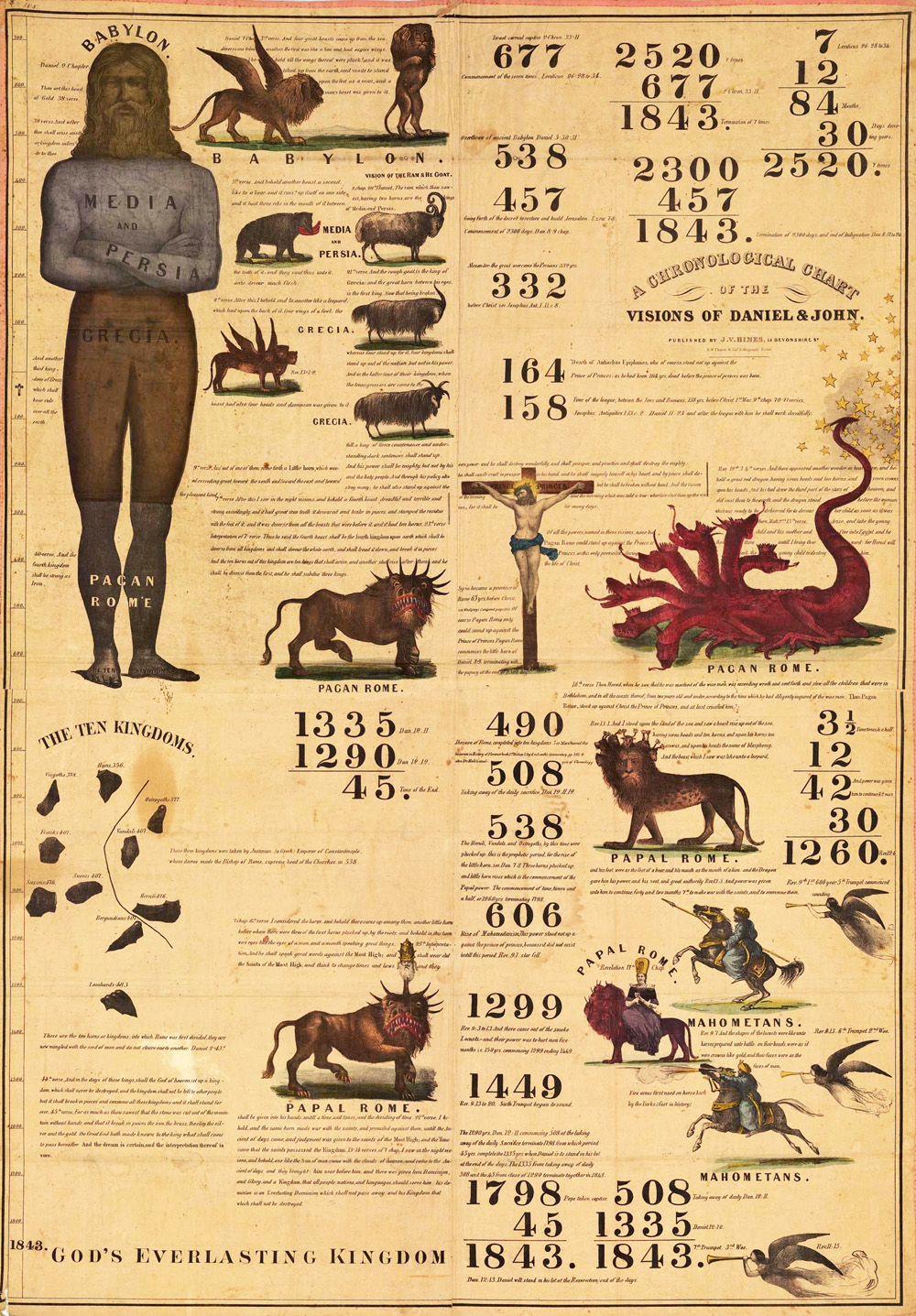
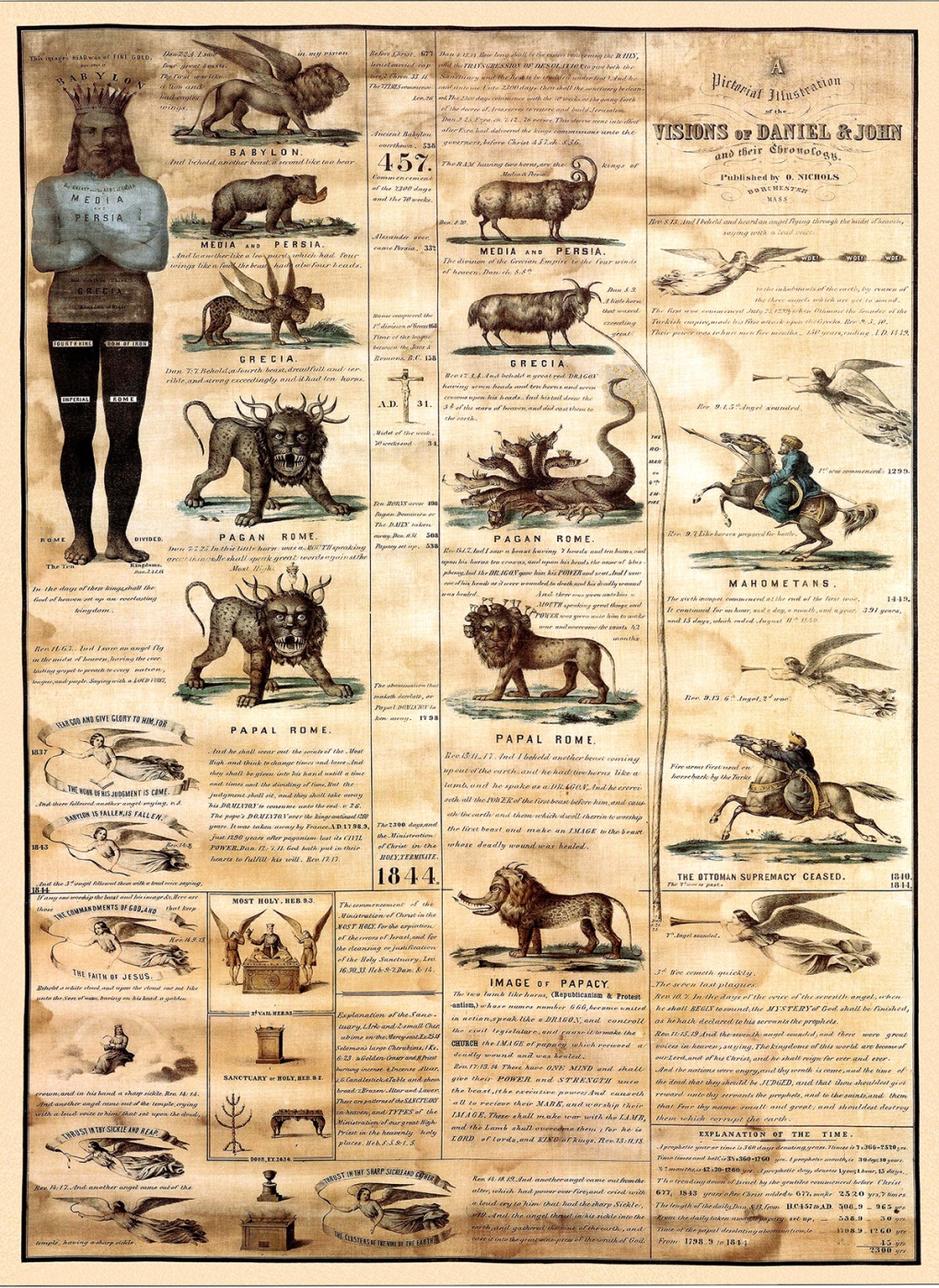
In 1840, John Dowling predicted Miller's 1843 prophecy would not come true. The following quote from Dowling's article An Exposition of the Prophecies, Supposed by William Miller to Predict the Second Coming of Christ, in 1843 , is equally applicable to the Watchtower Society.
"Mr. Miller is not the first expounder of prophecy that has attempted dogmatically to decide upon the very year of the coming of Christ. I will not occupy these pages by relating the individual histories of the wise and positive interpreters of prophetic times, who have preceded Mr. Miller in fixing the year of the Judgment. Their histories were all alike. They succeeded as Mr. M. has, in awakening a degree of alarm in the bosoms of some simple people, who forgot that Christ has said "of that day and hour knoweth no man" -- the time drew on -- the year passed by, and the prophet and his doctrine were forgotten. "
The reader but partially acquainted with the history of the world, and not aware of the manner in which Mr. M. continues to make his calculations all meet in the year 1843, thinks upon perusing the book that there are, to say the least, some very striking coincidences, and feels considerably staggered, if not convinced.
Let the reader peruse this passage and the chapter (Daniel 4) from which it is taken, and then imagine, if he can, by what stretch of ingenuity Mr. M. draws from it a proof of the coming of Christ to judgment in 1843.
He then looks into his Bible chronology, and finds that in the year BC 677 one of the kings of Judah, named Manasseh, was carried a prisoner to Babylon. Here, then, says Mr. M., must begin this punishment of seven times."
When 1844 proved to be false prophecy it was reworked by Second Adventists, such as Barbour. The start date was moved forward by 70 years to start in 606 B.C. and end in 1914 A.D. It was from Barbour that Russell took the idea that Daniel 4 is an end time prophecy, with the Gentile times expected to herald the conclusion of Armageddon.
Russell also took from Second Adventists the idea that measurements of the great pyramid could be used to calculate prophetic fulfilment, and that it pointed to 1914.
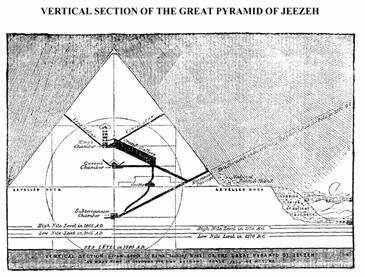
Studies in the Scriptures Series III - Thy Kingdom Come
"We find it to be 3457 inches, symbolizing 3457 years from the above date, B. C. 1542. This calculation shows A.D. 1915 as making the beginning of the period of trouble; for 1542 years B.C. plus 1915 years A.D. equals 3416 years. Thus the Pyramid witnesses that the close of 1914 will be the beginning of the time of trouble such as was not since there was a nation-no, not ever shall be afterward. " Studies In the Scriptures Series III - Thy Kingdom Come p.342
Did the Watchtower predict 1914 or 1874?
Current Watchtower publications are not transparent about the history of their interpretation of 1914. Russell and Rutherford believed that Jesus' invisible presence started in 1874. The end of the Gentile times in 1914 was to signify God's visible rulership returning to earth.
"Our Lord, the appointed King, is now present since October 1874, A.D., according to the testimony of the prophets, to those who have ears to hear it: and the formal inauguration of his kingly office dates from April 1878, A.D." Studies in Scriptures Series IV (1897) p.621
"The Scriptural proof is that the second presence of the Lord Jesus Christ began in 1874 A.D." Prophecy (1929) p.65
"From 1874 onward is the time of the Lord's second presence, as above stated.
...
This circumstantial evidence fulfilling prophecy is what constitutes the physical facts, and is proof corroborative of the Lord's presence since 1874; for this gathering work has been in progress particularly since that date.
...
His presence beginning in 1874, he has carried on his harvest work from 1874 forward, ... ." Our Lord's Return (1925) pp.29, 32, 36-37
It was not until the Golden Age 1930 p.503 that Rutherford stated for the first time that Christ's return and "presence" were 1914, instead of 1874.
Knowing this, it is eye opening to find Watchtower articles dishonestly claiming that the Organization always understood that 1914 was the year that began Jesus presence and rulership.
"Why, then, do the nations not realize and accept the approach of this climax of judgment? It is because they have not heeded the world wide advertising of Christ's return and his second Presence. Since long before World War I Jehovah's witnesses pointed to 1914 as the time for this great event to occur." Watchtower 1954 Jun 15 p.370
"... a prophecy providentially caused sincere 19th-century Bible students to be in expectation. By linking the "seven times" of Daniel 4:25 with "the times of the Gentiles", they anticipated that Christ would receive Kingdom power in 1914." Watchtower 1998 Sep 15 p.15
(For additional quotes see the section on 1914 under Changed Teachings)
What do the preceding mistruths suggest about the honesty and integrity of the Watchtower? If the Watchtower has no qualms about falsifying its own history, it should come as no surprise that they ignore the facts about the date 607 B.C.E. as well.
The original expectation that Jesus returned invisibly in 1874, and that the end of the Gentile times in 1914 would mark his kingdom's visible return was far more logical than the current view that it started invisibly in 1914. If the prophecy of the seven times was to signify the time that the end of God's visible rulership ended, then it would also be expected that it was to signify the time God's visible rulership would return to replace the kings of the earth. With the current interpretation, there is no way to prove whether or not God's invisible kingdom has begun ruling.
With the failure for the world's end to eventuate in 1914, most Adventist groups came to recognise that Daniel 4 was not intended to have a second prophetic fulfilment and stopped referring to it.
Over the last century there has been an accumulation of evidence that proves beyond doubt that the destruction of Jerusalem occurred between 586 and 587 B.C. An objective reading of the Bible and history accepts this without issue. The Watchtower Society has a vested interest in 1914 and hence 607 B.C., and so stringently attempts to dismiss any evidence to the contrary.
Daniel 4 is the only Scripture used by the Watchtower to specifically pinpoint 1914 as the year Jesus started to rule. If the Watchtower misapplies Daniel 4, there is no reason to think that the Last Days began October 2nd 1914. Related to this topic is whether the signs of Jesus' presence indicate the Last Days started in 1914.