
home > interesting topics > always been witnesses
Have There Always been Jehovah's Witnesses?
The Watchtower claims there have always been Jehovah's Witnesses. In that case, who were they prior to Russell? This article shows that not a single historical group has been found similar to Jehovah's Witnesses.
The Watchtower teaches there have always been Jehovah's Witnesses.
"Jehovah's witnesses have a history almost 6,000 years long, beginning while the first man, Adam, was still alive ... [Abel was] the first of an unbroken line of Witnesses ... Jesus' disciples were all Jehovah's witnesses ..." Jehovah's Witnesses in the Divine Purpose pp.8-9
Jehovah's Witnesses consider themselves part of:
"The one original religion introduced by mankind's Creator (as apposed to) the many counterfeit kinds introduced by his adversary." Awake! 1989 Jan 8 p.7
The Watchtower claims that since Jesus there have always been people that believe what the Watchtower teaches, at least in regards to the major doctrine. This is because "Jehovah has always guided his servants in an organized way" (pe p.192).
"Nevertheless, through all the centuries of apostasy, there would exist individual wheatlike Christians, genuine anointed ones. (Matthew 13:24-29, 36-43) Thus, when the Lord's day dawned in October 1914, there were still true Christians on earth." Revelation - Its Grand Climax at Hand! p. 31
If this is the case, why did God chose the "apostate" Catholic church to compile the Bible Canon in the 4th and 5th century and not use his true followers?
What proof has been provided to support this 6000 year, unbroken line? Not a single historical person or group since the second century has ever been identified as acceptable followers of Jehovah, even immediately prior to Pastor Russell. Russell was not a link in a line of a like minded group. He rejected his Presbyterian (Calvinist) Church, drifted through several Adventist groups, joined up with Barbour and then split from him to take control of his own unique way of worship. After forming a new religious group he shows he drew upon numerous Christian ideologies when saying;
"I confess indebtedness to Adventists as well as to other denominations." Zion's Watch Tower 1916 Jun 1 p.170
In an attempt to prove an unbroken line of Witnesses, the Watchtower has attempted to find religious groups with similar beliefs from prior centuries, occasionally discussing these groups in Watchtower articles. Historically there are very few groups similar to Jehovah's Witnesses and the ones the Watchtower mentions were around for only a fraction of the last 1900 years. The following research into the groups mentioned show that not a single group has ever believed all core Watchtower doctrine or can be shown to be acceptably referred to as Jehovah's Witnesses.
For a group to be classified as one of Jehovah's Witnesses, it is not necessary for them to have understood and taught every current Witness doctrine, such as the Great Crowd and end time prophecies. However, there are several key teachings that they must have held. For the last 2000 years it should be possible to find an ongoing group of believers who were;
- Anti-Trinitarian
- Using Jehovah or it's equivalent translation as God's name
- Not teaching hellfire
- Not teaching immortality of the soul
- Not participating in war
- Not engaging in Idolatry or spiritism
- Accepting the Ransom
- Preaching
When the Watchtower writing department was researching this topic for the Proclaimers book in the 1990's, Carl Adams gave Barbara Anderson[2] just four criteria:
- rejection of the Trinity
- rejection of hellfire
- rejection of immortality of the human soul
- acceptance of the ransom sacrifice of Christ as defined by Jehovah's Witnesses
Even with this short list, not a single group could be found. The result is that the Proclaimers book was reduced to making the following broad statement:
"Throughout the centuries there have always been truth lovers. To mention just a few: John Wycliffe (c. 1330-1384) and William Tyndale (c. 1494-1536) furthered the work of Bible translation even at the risk of their life or freedom. Wolfgang Fabricius Capito (1478-1541), Martin Cellarius (1499-1564), Johannes Campanus (c. 1500-1575), and Thomas Emlyn (1663-c. 1741) accepted the Bible as God's Word and rejected the Trinity. Henry Grew (1781-1862) and George Storrs (1796-1879) not only accepted the Bible and rejected the Trinity but also expressed appreciation for the ransom sacrifice of Christ. Although we cannot positively identify any of such persons as "the wheat" of Jesus' illustration, certainly "Jehovah knows those who belong to him."" Jehovah's Witnesses-Proclaimers of God's Kingdom p.44
The majority of these people believed the Trinity, and hence that Jesus is God, so were not Jehovah's Witnesses. No one is mentioned prior to 1300 A.D., as before then few people had access to the Bible, apart from the Catholic clergy. Their belief system was necessarily Catholic, so few groups developed a belief system even vaguely similar to Watchtower teachings.
During the 150 year period from Henry VIII to Charles I (1500 and 1600's) anti-Trinitarianism was pursued consistently and vigorously by 'heretics.' During this short period there were groups that did not believe the Trinity, but these 'heretics', such as the Unitarian Bishop of Transylvania (Hungary), had such radical views in other areas they cannot be acceptably referred to as Jehovah's Witnesses.
In 1919, The Finished Mystery pp.23-72 claimed that the Seven Messengers of Revelation 2 and 3 were St Paul, St John, Arius, Waldo, Wycliffe and Luther and Russell. However Waldo, Wycliffe and Luther were Catholics and Protestants whose beliefs were strongly at odds to both Russell and the essential doctrine listed above.
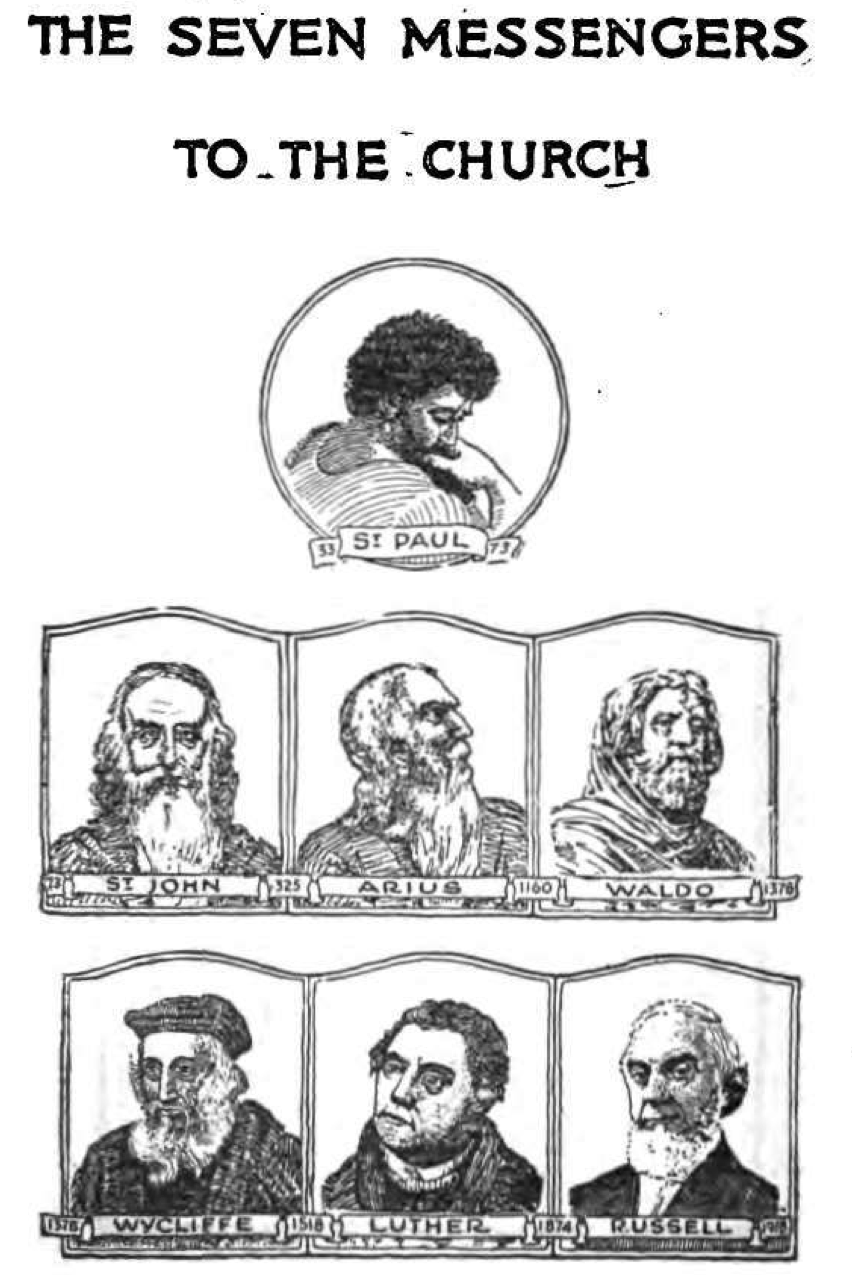
The groups closest to Jehovah's Witnesses that have been mentioned in Watchtower publications are the Waldenses, Cathari, Albigenses, Paulicians, Lollards and Huguenots. These were all basically Protestants and adhered to many Protestant teachings considered wrong by the Watchtower Society. The Minor Brethern (Socianians) are most similar to Jehovah's Witnesses today, yet the following information about each of these groups identifies that none could be acceptably described as Jehovah's Witnesses.
Albigenses or Cathari
Cathari are made to sound like Jehovah's Witnesses.
"Yet another movement got started in the 12th century in the south of France-the Albigenses (also known as Cathari), named after the town of Albi, where they had many followers. They had their own celibate clergy class, who expected to be greeted with reverence. They believed that Jesus spoke figuratively in his last supper when he said of the bread, "This is my body." (Matthew 26:26, NAB) They rejected the doctrines of the Trinity, the Virgin Birth, hellfire, and purgatory. Thus they actively put in doubt the teachings of Rome. Pope Innocent III gave instructions that the Albigenses be persecuted. "If necessary," he said, "suppress them with the sword."" Mankind's Search for God pp. 281-282
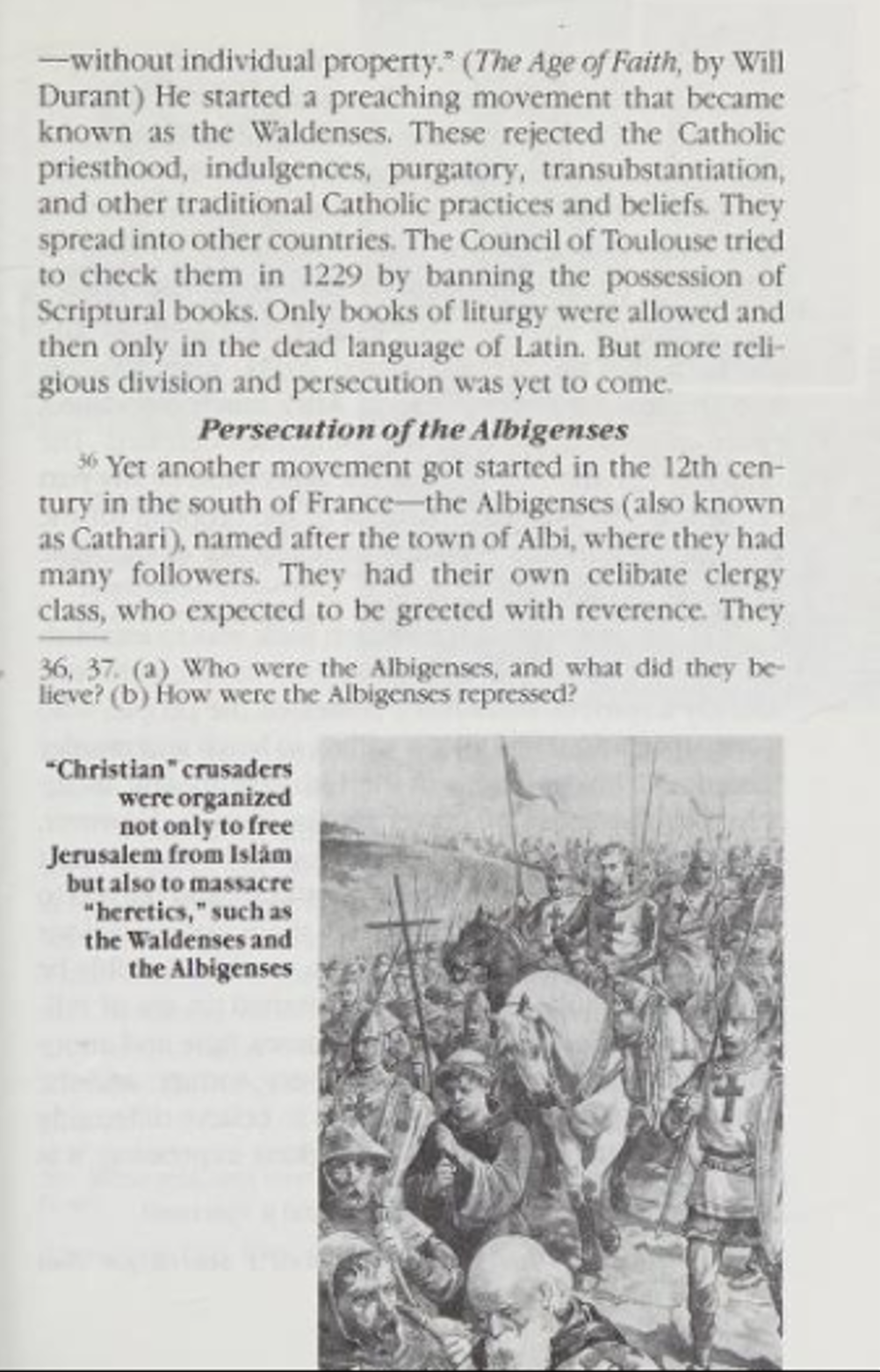
However the Watchtower is forced to admit they held to key teachings that contradicted the Bible and so can not be considered Jehovah's Witnesses.
"Although the Cathari quoted the Bible extensively, they viewed it primarily as a source of allegories and fables .Many Cathar teachings were in direct contradiction to the Bible. For instance, they believed in the immortality of the soul and in reincarnation." Watchtower 1995 Sep 1 p.29 The Cathari-Were They Christian Martyrs?
Waldenses
"Most historians agree that the movement had its start about the year 1170. Poverty, preaching, and the Bible were at the heart of Vaudès' life .Among other things, the early Waldenses rejected lying, purgatory, Masses for the dead, papal pardons and indulgences, and the worship of Mary and the "saints." They also held annual observances of the Lord's Evening Meal, or Last Supper. According to Lambert, their form of worship "was, in effect, the religion of the ordinary layman .Over the centuries, Waldensian churches have been established in countries as far away from as and the . However, most historians agree with Audisio, who says that "Waldensianism came to an end at the time of the Reformation," when it was "swallowed up" by Protestantism." Watchtower 2002 Mar 15 pp.20-21 The Waldenses-From Heresy to Protestantism.
The New Catholic Encyclopeadia says the Waldenses were so similar to Cathari that they are assumed to be an offshoot of them. They held to many strange teachings, such as encouraging members to dissolve their marriages in order to live nomadic lives of poverty and continued to take sacrament in the Catholic Church.
Paulicians
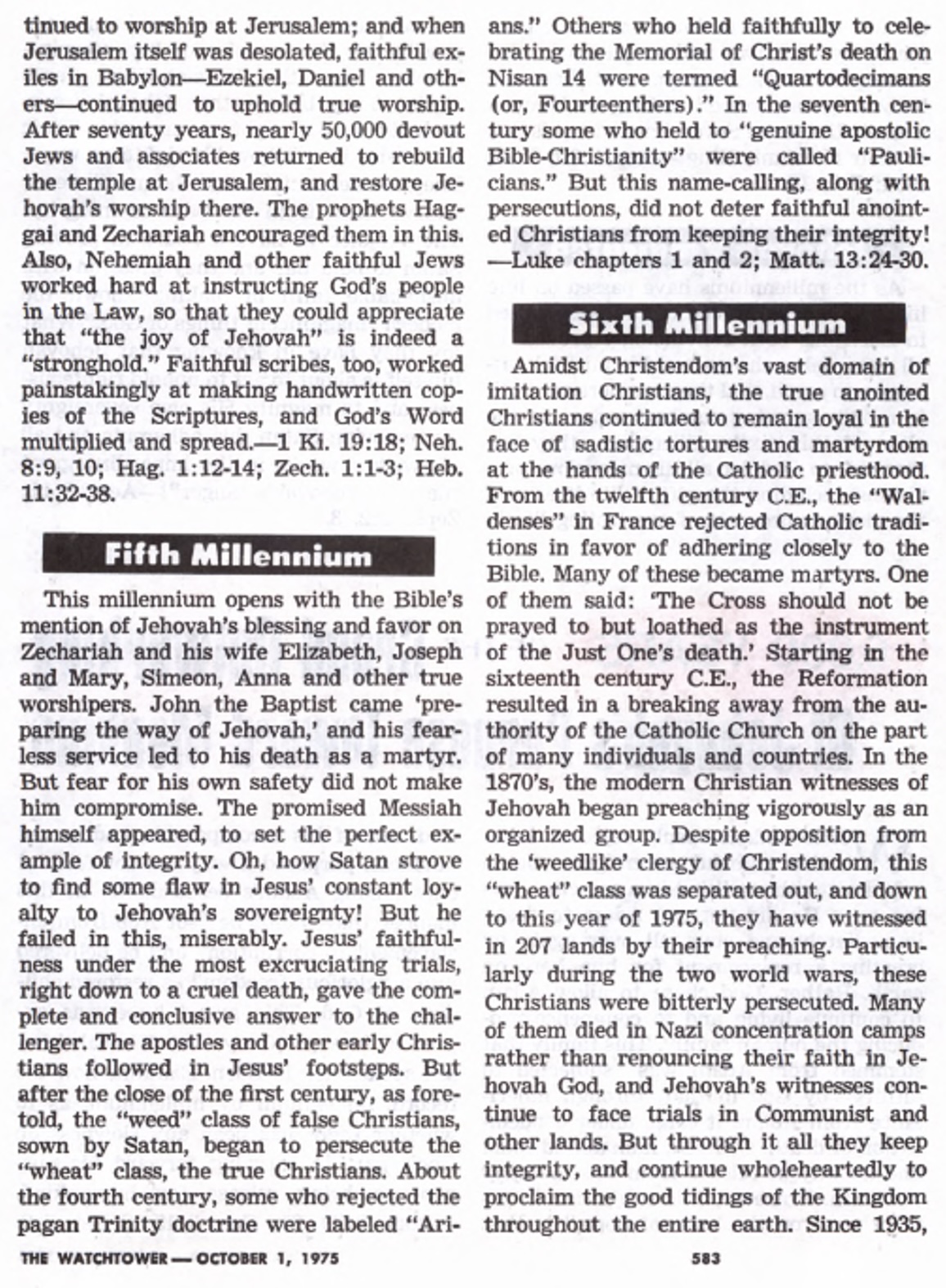
A 1975 Watchtower article describes the progression of "true Christians" in the "Fifth Millennium." This included first century Christians, fourth century Christians that rejected the Trinity and Quartodecimans that celebrated the Memorial of Jesus' death.
Paulicans are described as following genuine Christianity.
"In the seventh century some who held to "genuine apostolic Bible-Christianity" were called "Paulicians."" Watchtower 1975 Oct 1 p. 583
"... witnesses of Jehovah on earth in every period of human history. ... Then there were the Paulicians from the seventh century onward, whose teachings have been termed "genuine apostolic Bible-Christianity." They stood solely by the "New Testament," practiced adult baptism, believed that God in his love had sent an angel to earth who at his baptism became God's Son. They rejected unscriptural tradition, had no clergy-laity distinction, refused to revere the cross." Watchtower 1965 Mar 15 p.192
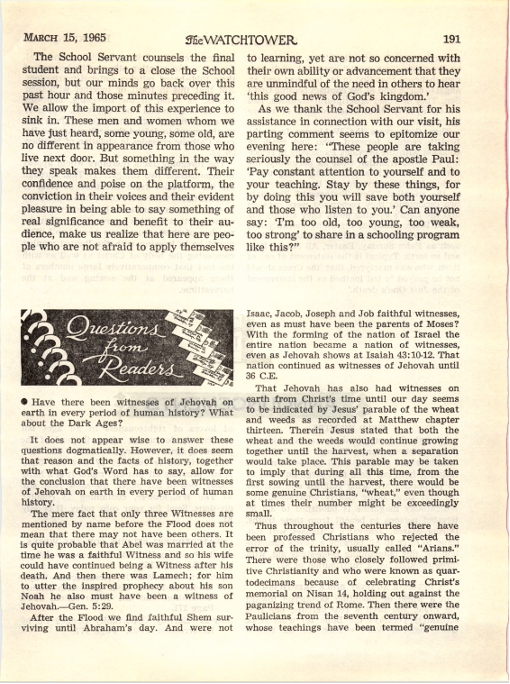
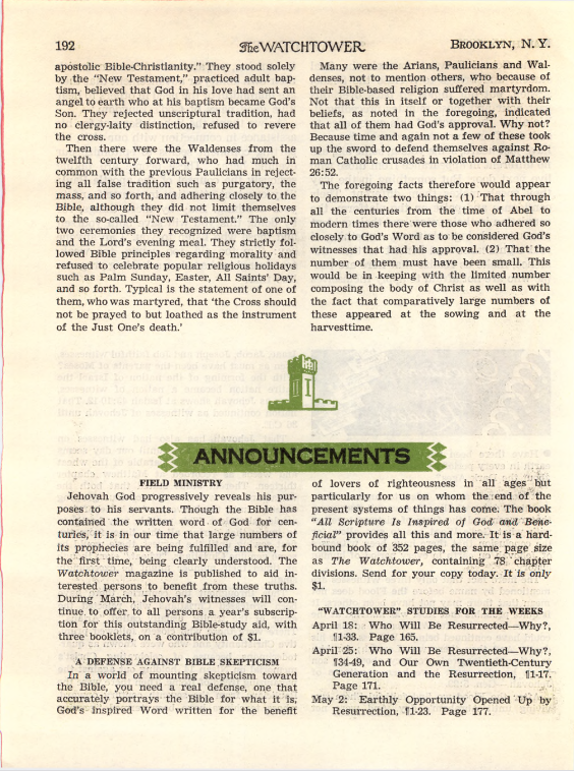
The 1965 article misleadingly says this group was from "the seventh century onward". Though flourishing between 650 and 872, they had disappeared by the middle ages.
Most certainly, their teaching bore little resemblance to Jehovah's Witnesses. Their beliefs stemmed from the Gnostist teachings of the second century heretic Marcion. They rejected the Old Testament and the books of Peter, principally following the books of Paul, hence the name. Though they rejected the trinity they did not share the Watchtower's Arian viewpoint, but rather had a dualistic concept of God.
For more details about the Paulicians see newadvent.org/cathen/11583b.htm, britannica.com/EBchecked/topic/447143/Paulicians and en.wikipedia.org/wiki/Paulicians (Sep 12 2008)
Lollards
John Wycliffe and the Lollards were the most significant heretical group in England before the Reformation.
"His followers, the Lollards, were more determined than ever to keep Wycliffe's work alive .The Bible was appealed to in support of what was taught. In training the preachers, Wycliffe himself had stressed the need to follow the simple instructions that Jesus had given when he sent out the 70 disciples. They roundly denounced pilgrimages, superstitions, indulgences, saints, shrines and the use of images. Gradually, certain prominent Lollards realized that they could no longer remain within the Church. ... Do we today appreciate the courage that may have been displayed by our ancestors? They cherished the Bible as a book worth reading and studying-indeed worth their land, freedom and life. Does that hard-won freedom to study the Scriptures count with us? We can only say that it does if we ourselves take up study of the Bible and display an active faith, sharing its truths with others." Watchtower 1980 August 1 p.24 The Lollards, Courageous Bible Preachers
The Encyclopædia Britannica 2002 Expanded Edition DVD states:
"The most complete statement of early Lollard teaching appeared in the Twelve Conclusions, drawn up to be presented to the Parliament of 1395. They began by stating that the church in England had become subservient to her "stepmother the great church of Rome." The present priesthood was not the one ordained by Christ, while the Roman ritual of ordination had no warrant in Scripture. Clerical celibacy occasioned unnatural lust, while the "feigned miracle" of transubstantiation led men into idolatry. The hallowing of wine, bread, altars, vestments, and so forth was related to necromancy. Prelates should not be temporal judges and rulers, for no man can serve two masters. The Conclusions also condemned special prayers for the dead, pilgrimages, and offerings to images, and they declared confession to a priest unnecessary for salvation. Warfare was contrary to the New Testament, and vows of chastity by nuns led to the horrors of abortion and child murder. Finally, the multitude of unnecessary arts and crafts pursued in the church encouraged "waste, curiosity, and disguising." The Twelve Conclusions covered all the main Lollard doctrines except two: that the prime duty of priests is to preach and that all men should have free access to the Scriptures in their own language."
Lollards share some similarities with Jehovah's Witnesses, having strong focus on Bible reading, preaching, and were against idolatry, celibacy and war. However, Lollards can not be considered Jehovah's Witnesses as they worshipped a Trinity. Nor can they be referred to as the Slave dispensing spiritual food, as there was no central authority or central doctrine.
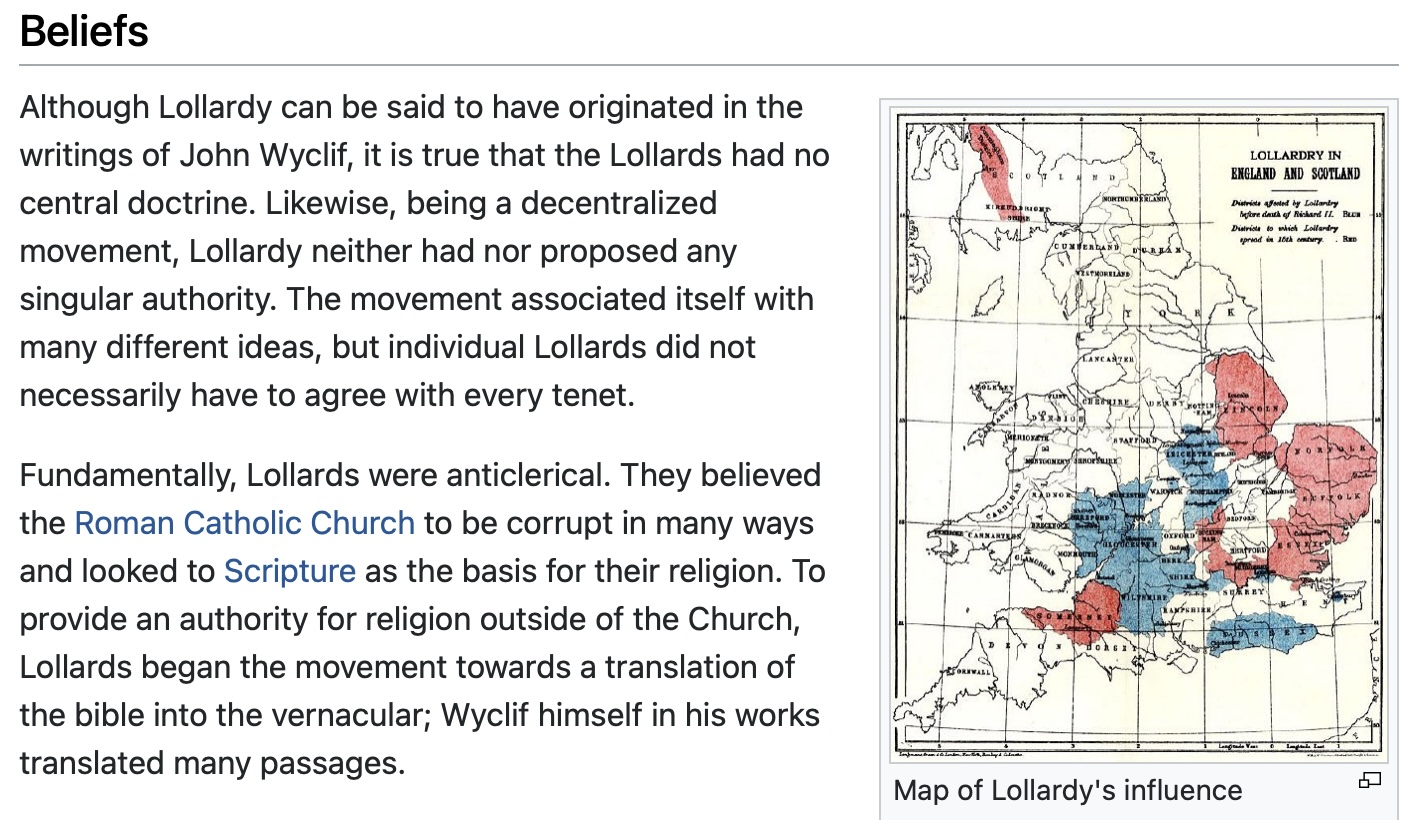
Source: https://www.newworldencyclopedia.org/entry/Lollardy (12 Feb 2024)
Huguenots
Another group that the Watchtower has mentioned is Huguenots, but this was just another name for Protestants.
"Tired of waiting for changes, many members of the movement for reform within the Catholic Church sided with Protestantism. About 1560, numerous French aristocrats and their supporters joined the Huguenots, as Protestants had come to be called." Awake! 1997 Apr 22 p.5
Anabaptists, Socinians, Brethren Minor
The groups closest to current Watchtower teaching were the Anabaptists, Socinians and Brethern of the Minor Party. These were all closely related and lasted for around 100 years during the late 1500's. These groups had strong views against the Trinity, infant baptism and other Catholic doctrines.
The following Watchtower article from 2003 gives the distinct impression that they were just like Jehovah's Witnesses today by showing a number of similarities.
"What the Brethren of the Minor Party Believed
The following quotes from the 15th- and 16th-century Acta Unitatis Fratrum show some of the beliefs held by the Minor Party. The statements, written by leaders of the Minor Party, are primarily directed to the Major Party.
Trinity: "If you glance throughout the entire Bible, you will not find that God is divided into a kind of Trinity, three persons by names, as people fabricated in their fancies."
Holy spirit: "The holy spirit is God's finger and a gift of God, or a comforter, or God's Power, which the Father gives to believers on the basis of Christ's merits. We do not find in the Holy Scriptures that the holy spirit should be called a God or a Person; nor do the apostolic teachings show that."
Baptism: "The Lord Christ told his apostles: Go into all the world, preach the Gospel to all creation, to those who would believe. (Mark, chapter 16) And only after these words: and being baptized, they will be saved. And you teach to baptize little children who lack their own faith."
Neutrality: "What your early brothers viewed as bad and unclean, to join the army and murder or to walk the very roads clothed with weapons, all that you consider to be good . . . So we feel that you, along with other teachers, look only with your left eye at the prophetic words that point out: Thus he broke the power of the bow, the shields and the sword and the battle. (Psalm 75) And again: They shall not hurt or destroy in all my holy mountain, for the Lord's earth shall be full of the divine knowledge, and so forth. (Isaiah, chapter 11)."
Preaching: "We well know that, initially, females have brought more people to repentance than all the priests along with a bishop. And now the priests settled at their places and their apportioned rectories. What a mistake! Go into the entire world. Preach . . . to all creation." Watchtower 2003 Dec 15 p.12
However, in 1988 it had been shown that these too "were guilty of many errors", such as their belief in reincarnation and denial of the ransom.
"Like the religions around them, they were guilty of many errors. Still, of all the religions of the Reformation, this rivulet of Socinianism adhered to the Bible more than most. The Minor Reformed Church (as Socinians were officially called) flourished in for nearly a hundred years. At their peak they numbered up to 300 congregations. Awake! 1988 Nov 22 pp.19-20 The Socinians - Why Did They Reject the Trinity?
"When the storm of the Protestant Reformation erupted in the 16th century, a radical group called the Socinians was born. They denied that Jesus' death in any way "merited salvation for us," calling such belief "fallacious, erroneous, and very pernicious . . . , repugnant both to Scripture and reason."" Watchtower 1991 Feb 15 p.6
Though not believing in the Trinity this groups understanding about the nature of God can hardly be deemed acceptable to Jehovah's Witnesses. Anabaptists did not share the Arian concept of God taught by the Watchtower Society. They believed in Modalism, the notion that there is one unique God that manifests Himself in three different modes or stages; the Father in the Old Testament, the Son in the four Gospels and the Holy Spirit since Pentecost.
Conclusion
It is common for high control groups to claim to be the only true religion, a copy of original Christianity and to have existed since Jesus, rather than since their historical introduction.
"The name "Christadelphian" was first used in the mid-1800s, but we believe that there have been people who share our beliefs throughout history." christadelphian.org.uk (15 Jan 2006)
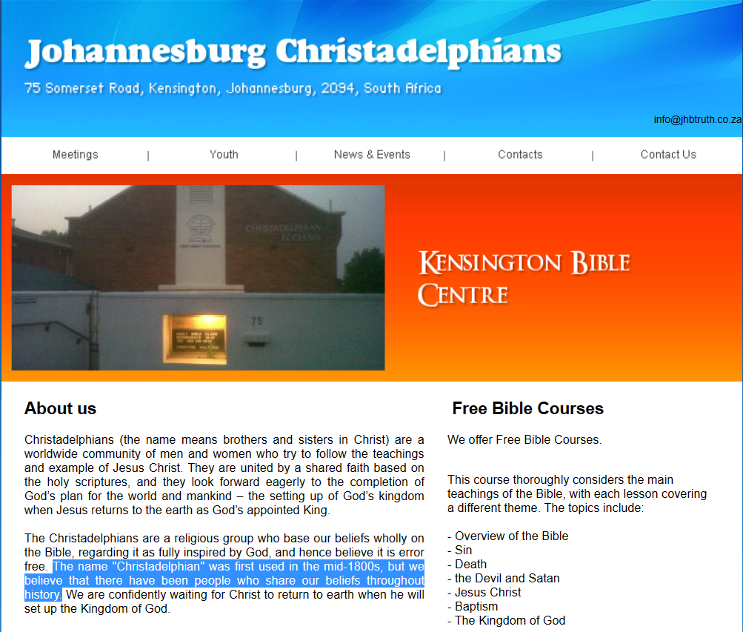
Likewise, the Watchtower Society claims the leadership are part of a direct line back to Jesus; and Jehovah's Witnesses span 6,000 years. Such assertions are impressive at promoting devotion to such organizations, but fail under scrutiny. If anyone has right to such a claim it is surely only the Catholic and Orthodox Churches.
The Watchtower Society cannot trace its roots back to Jesus; it cannot even prove the first step to a group before Pastor Russell. Not a single known historical Christian religion has lived up to the essential basic Watchtower beliefs and standards. Furthermore, a study of the history of the Watchtower Society reveals that prior to 1930, Watchtower followers varied greatly with Jehovah's Witnesses today. With Rutherford's significant overturn of Watchtower teachings during the 1920s and 1930s, it is even difficult to rightfully categorise its founder Russell as one of Jehovah's Witnesses.
Related to the topic of whether there have always been Jehovah's Witnesses are the articles:
- Is an Organization Required?
- Who are the Faithful and Discreet Slave?
- Was there a first century Governing Body?
Written 2007. Latest update Jan 2024.
 Paul Grundy 2005 - 2025