
home > changed teachings > toasting
Toasting Changes
After many decades of not being allowed to toast, Jehovah's Witnesses were given permission in 2025. Watchtower had reasoned that these practices were a salute to pagan gods, and clinking glasses was to scare away demons.

This change highlights several issues with Watchtower teachings.
- Contradictory Statements about Pagan Practices
- Incorrect that Toasting was to gods
- Changing Stance
- Conscience matters are not up to one’s Conscience
- Coercive Persuasion
Contradictory Statements about Pagan Practices
It does not follow that a practice should be avoided on the basis that pagan people used to engage in it. This is discussed in detail at Pagan Practices and Doctrine. People of ancient times engaged in many practices that are commonly acceptable today, and what is relevant is how people view that practice today. Watchtower has always said as much.
“A main concern is, not what the practice meant hundreds of years ago, but how it is viewed today in your area." Awake! 2003 Sep 22 p.24
"However, if one’s motive in putting up a wind chime has nothing to do with false religion, superstition or demonism... it is a simple matter for personal decision." Watchtower 1981 Jun 1 p.31
Incorrect that Toasting is a Pagan Practice
People toast before enjoying a drink because it adds to the communal enjoyment by involving all five senses in the drink – the sound of the glasses being clinked, the look of the deep colour of the wine, the smell of its bouquet, the feel in one’s mouth, and lastly the taste.
Watchtower forbad toasting on the basis that in ancient times it was a “religious rite of drinking to the gods and the dead.”
“The Bible does not mention toasting, so why do Jehovah’s Witnesses avoid sharing in toasts? ... The Encyclopædia Britannica (1910), Volume 13, page 121: “The custom of drinking ‘health’ to the living is most probably derived from the ancient religious rite of drinking to the gods and the dead. The Greeks and Romans at meals poured out libations to their gods, and at ceremonial banquets drank to them and to the dead.”” Watchtower 2007 Feb 15 p.30
Consider the first sentence, “The Bible does not mention toasting.” Watchtower went beyond the Scriptures when introducing this as rule.
Notice also that their source says it is only probable (not certain) that toasting was to gods. Other sources claim this was not the case. Whether or not some people toasted to “gods and the dead,” this has not been the reason for centuries. Toasting became a common practice after the excessive fear of demons had largely passed. One reason for toasting was to indicate that the wine was not poisoned, and another was to involve all five senses in the enjoyment of a drink. See Why Do We Clink Wine Glasses? Barbara Mikkelson Snopes.com 8 Mar 2007.
Changing Stance
The Governing Body claims its teachings are the truth, directed by Jehovah. It proves otherwise each time it changes it rules. For decades, the Governing Body forbade Jehovah’s Witnesses from enjoying toasting before a meal, and then suddenly said this is not an issue after all.
Unacceptable
Watchtower prevented toasting on the basis that it was to false gods, separating Jehovah’s Witnesses from “worldlings” who are destined for destruction.
"A common practice at weddings and on other social occasions is toasting. The 1995 International Handbook on Alcohol and Culture says: “Toasting . . . is probably a secular vestige of ancient sacrificial libations in which a sacred liquid was offered to the gods . . . in exchange for a wish, a prayer summarized in the words ‘long life!’ or ‘to your health!’” True, many people may not consciously view toasting as a religious or superstitious gesture. Still, the custom of lifting wine glasses heavenward might be viewed as a request to “heaven”—a superhuman force—for a blessing in a way that does not accord with that outlined in the Scriptures." “Keep Yourselves in God’s Love” (2008) chapter 13 Celebrations That Displease God
"The Bible does not mention toasting, so why do Jehovah’s Witnesses avoid sharing in toasts?" Watchtower 2007 Feb 15 p.30
"Is it proper for Christians to "drink a toast" when they get together? ... A mature Christian would also avoid even imitating false religious rituals. This spiritually mature course would please Jehovah. Remember, God specifically warned the Israelites against copying religious practices of the pagan nations round about them." Watchtower 1968 Jan 1 p.31
"Is it proper to propose of to drink toasts to God or Christ of the Kingdom? ... This practice is rooted far back in paganism. The Babylonians drank toasts to their Gods, and ended up drunk. ... Such toast-drinking is in no way comparable with the drink offerings Jehovah God prescribed for his temple service. … In shunning this custom of toasting, along with many other objectionable customs, we may appear narrow-minded to worldlings. So we are. But never forget for a moment that our Christian narrowness is our salvation, just as the world’s broadness is its destruction." Watchtower 1952 May 15 pp.318-319
Acceptable
In 2025, Watchtower did a complete reversal by making toasting acceptable.
"Therefore, after prayerful consideration, the Governing Body has concluded that there is no need to make a rule regarding toasting and clinking glasses. Each Christian should use the principles that we have discussed in this update and his own Bible-trained conscience to make a good decision. What does this mean? Are we saying that toasting is OK now at all times and in every situation? Of course not. We are simply saying that there is no need to make a rule." 2025 Governing Body Update #4
Conscience Matters are not up to one’s Conscience
The 2025 Governing Body update said that toasting is for Jehovah’s Witnesses to decide, based on their “own Bible-trained conscience.” This highlights how insignificant the conscience of Jehovah’s Witnesses is. The Governing Body make unsupported rules that must be followed, then when they change their mind and make a forbidden practice allowed, choosing to begin the practice is up to their conscience. In other words, adherents are not allowed to use their Bible trained conscience to make decisions, until the Governing Body lays out what they may now think.
High Control Religious Persuasion
As shown above, there was never any solid reason for the Governing Body preventing Jehovah’s Witnesses from enjoying the practice of toasting. This is indicative of a group of leaders using coercive persuasion to manipulate its adherents.
It is worth revisiting the Watchtower 2007 article that concluded toasting is wrong. This Watchtower article presented detailed points for why toasting is acceptable. It outlined that:
- Toasting is not forbidden in the Bible
- It is fine to wish someone good health
- Source quotes are uncertain of a pagan connection, labelling it only as probable
- Pagan roots do not make something unacceptable
- Faithful Israelites would raise their hands to God
- Toasting it not considered a religious gesture in modern times
I have highlighted in bold where each of these comments appears in the 2007 Watchtower article.
“The Bible does not mention toasting, so why do Jehovah’s Witnesses avoid sharing in toasts?
Toasting with a glass of wine (or another alcoholic beverage) is a long-standing and widespread practice, though details may differ from place to place. Sometimes those toasting clink their glasses together. The person offering the toast usually requests or wishes someone happiness, good health, a long life, or the like. Others sharing in the toast may voice their agreement or raise their glasses and drink some wine. For many, this seems a harmless custom or social grace, but there are good reasons why Jehovah’s Witnesses do not share in toasting.
It is not because Christians do not hope that someone finds happiness and enjoys good health. In a letter to the congregations, the first-century governing body concluded with a word that can be rendered “good health to you,” “keep well,” or “fare well.” (Acts 15:29) And some true worshippers said to human kings: “Let my lord . . . live to time indefinite” or “Let the king himself live to time indefinite.”—1 Kings 1:31; Nehemiah 2:3.
What, though, is the background of the custom of toasting? The Watchtower of January 1, 1968, quoted The Encyclopædia Britannica (1910), Volume 13, page 121: “The custom of drinking ‘health’ to the living is most probably derived from the ancient religious rite of drinking to the gods and the dead. The Greeks and Romans at meals poured out libations to their gods, and at ceremonial banquets drank to them and to the dead.” The encyclopedia added: “Intimately associated with these quasi-sacrificial drinking customs must have ever been the drinking to the health of living men.”
Is that still valid? The 1995 International Handbook on Alcohol and Culture says: “[Toasting] is probably a secular vestige of ancient sacrificial libations in which a sacred liquid was offered to the gods: blood or wine in exchange for a wish, a prayer summarized in the words ‘long life!’ or ‘to your health!’”
Granted, the fact that an object, a design, or a practice has roots or parallels in ancient false religion does not always rule such out for a true worshipper. Consider the pomegranate. A noted Bible encyclopedia reports: “The pomegranate seems also to have been used as a holy symbol in heathen religions.” Nevertheless, God had pomegranates made of thread put on the hem of the high priest’s garment, and pomegranates decorated the copper pillars of Solomon’s temple. (Exodus 28:33; 2 Kings 25:17) Moreover, the wedding ring at one time had religious significance. Yet, most people today do not know that, considering a wedding ring a mere evidence that someone is married.
What about using wine in connection with religious acts? For instance, at one point Baal-worshipping men of Shechem “went into the house of their god and ate and drank and called down evil upon Abimelech,” Gideon’s son. (Judges 9:22-28) Do you think one loyal to Jehovah would have shared in that drinking, perhaps calling for a divine influence against Abimelech? Describing a time when many in Israel revolted against Jehovah, Amos said: “They stretch themselves out beside every altar; and the wine of those who have been fined they drink at the house of their gods.” (Amos 2:8) Would true worshippers have shared in such, whether the wine was poured out as a libation to the gods or just drunk in that connection? (Jeremiah 7:18) Or would a true worshipper lift up a glass of wine and ask for a divine influence on someone or a blessed future for him?
Interestingly, worshippers of Jehovah at times raised their hands and asked for a good outcome. They lifted their hands to the true God. We read: “Solomon began standing before the altar of Jehovah . . . and he now spread his palms out to the heavens; and he went on to say: ‘O Jehovah the God of Israel, there is no God like you . . . and may you yourself hear at the place of your dwelling, in the heavens, and you must hear and forgive.’” (1 Kings 8:22, 23, 30) Similarly, “Ezra blessed Jehovah . . . at which all the people answered, ‘Amen! Amen!’ with the lifting up of their hands. They then bowed low and prostrated themselves to Jehovah.” (Nehemiah 8:6; 1 Timothy 2:8) Clearly, those loyal ones were not lifting their hands heavenward for a blessing from some god of luck.—Isaiah 65:11.
Many people today who share in toasts may not think that they are requesting response or blessing from some god, but neither can they explain why they lift their wine glasses heavenward. Nevertheless, the fact that they do not think the matter through is no reason for true Christians to feel obliged to imitate their gestures.
It is common knowledge that on other matters also, Jehovah’s Witnesses abstain from making gestures that most people do perform. For instance, many people make gestures toward national emblems, or flags; they do not view such gestures as acts of worship. True Christians do not interfere with such gestures, but they do not personally participate. Knowing when such a ceremony may occur, many Witnesses have acted with discretion so as not to offend others. In any case, they are determined not to make patriotic gestures, which are out of harmony with the Bible. (Exodus 20:4, 5; 1 John 5:21) Toasting today may not be viewed by many as a religious gesture. Still, there are valid reasons why Christians do not share in toasting, which has a religious background and even now can be viewed as asking ‘heaven’ for a blessing, as if seeking aid from a superhuman force.—Exodus 23:2.” Watchtower 2007 Feb 15 pp.30-31
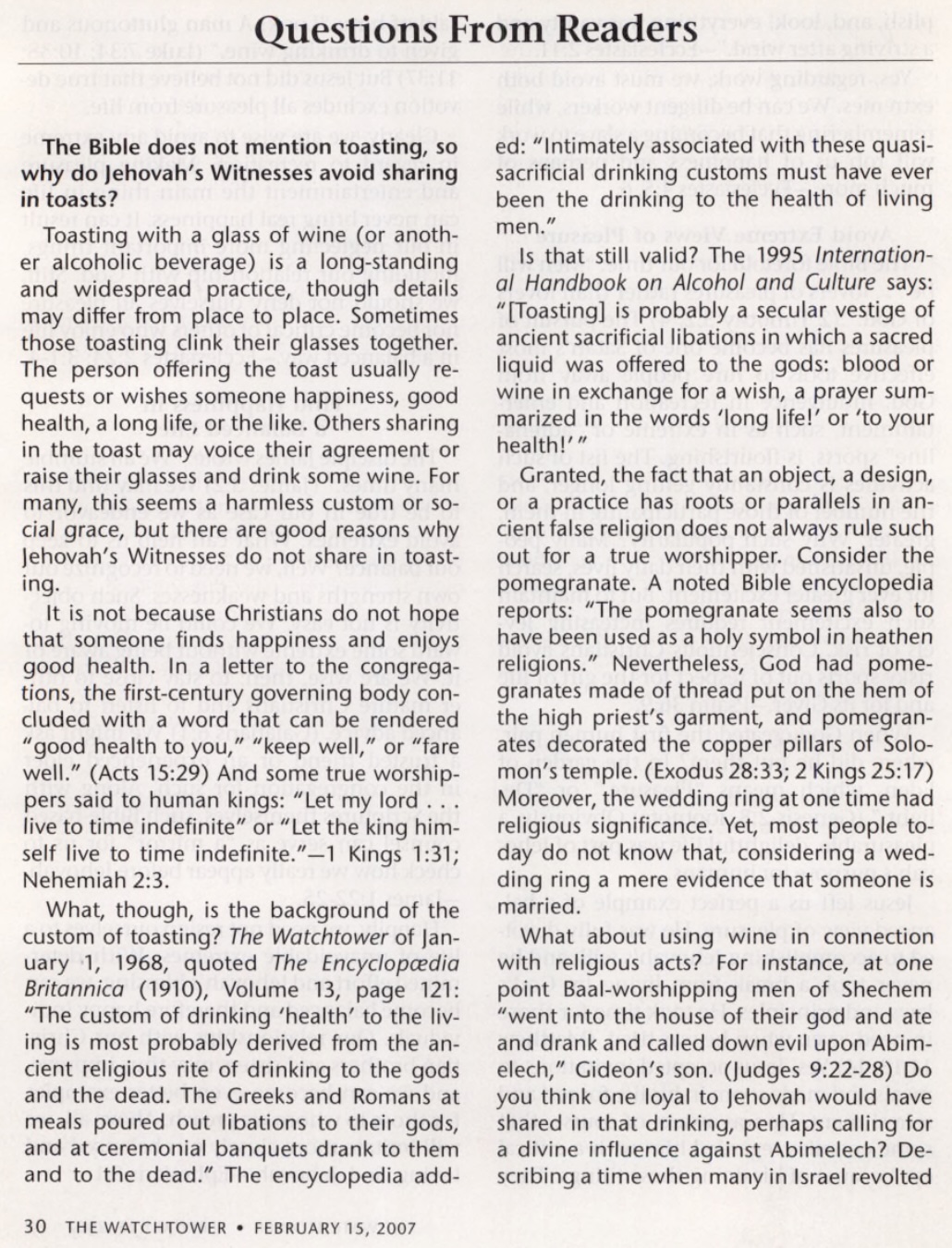
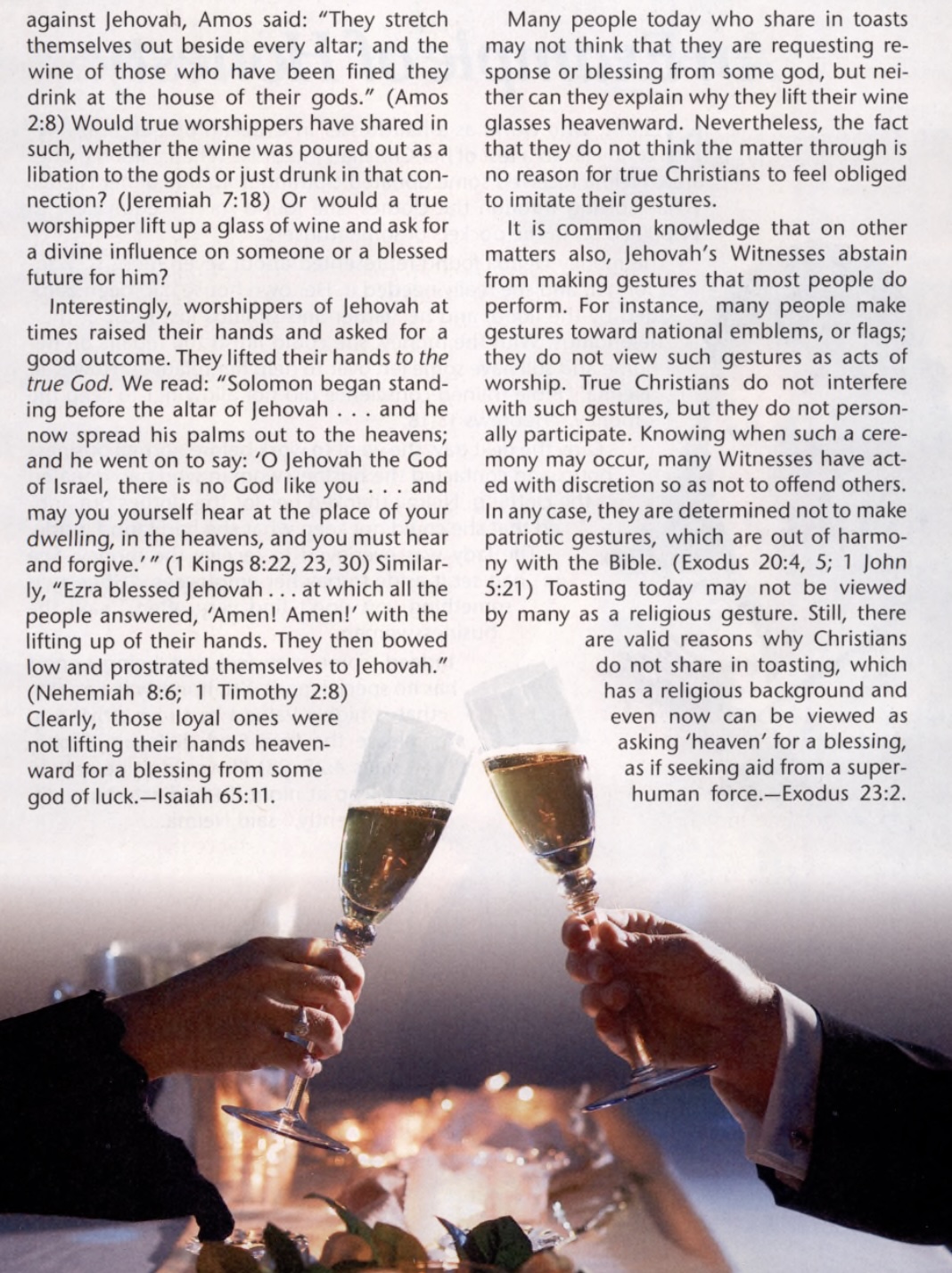
This article presents information supporting one conclusion, and then blatantly arrives at the opposite conclusion, that it seems almost as if the Governing Body were testing how gullible the followers are. After providing a range of reasons proving toasting is fine, the Watchtower article ends that Jehovah’s Witnesses are not to toast! This is a disturbing example of how strong the control of religious leaders can be. Despite showing why toasting is acceptable, the Governing Body illogically stated Jehovah’s Witnesses must not toast, and Jehovah’s Witnesses mindlessly followed this rule for another 18 years, until their leaders told them otherwise.
Written January 2026.
 Paul Grundy 2005 - 2026