
home > core concepts > slave


Faithful and Discreet Slave
The parable of the "faithful and discreet slave" is used by Watchtower's Governing Body to justify that in 1919 Jehovah appointed them to lead his people, and that salvation depends on following their directions.
This article is part of the series:
Faithful & Discreet Slave - Does Watchtower's Governing Body represent the faithful and discreet slave, and do they need to be obeyed to "have Jehovah's approval?"
Directed by Holy Spirit - Is the Governing Body directed by holy spirit, and if so, how can it claim to be neither infallible or inspired?
Governing Body - Was there a first century governing body, and how did Watchtower's Governing Body develop?
Organization - Does Jehovah require an Organization and has he always used one?
Matthew 24 and Luke 12 record a number of Jesus' parables, or stories, one of which refers to a faithful and discreet slave.
Matthew 24:45-47 "Who really is the faithful and discreet slave whom his master appointed over his domestics, to give them their food at the proper time? Happy is that slave if his master on arriving finds him doing so. Truly I say to YOU, He will appoint him over all his belongings."
Luke 12:42-44 "And the Lord said: “Who really is the faithful steward, the discreet one, whom his master will appoint over his body of attendants to keep giving them their measure of food supplies at the proper time? Happy is that slave if his master on coming finds him doing so! I tell you truthfully, he will appoint him over all his belongings."
The faithful slave is a reference to Joseph, who served Potiphar faithfully whilst he was away. Jesus provided this as an example for all Christians to follow.
Rather than accept this as an example of integrity, Watchtower presents it as a prophecy. This apparent prophecy is fundamental to the foundation of the religious structure of Jehovah's Witnesses, with the claim this parable foretold that in 1919, Jesus chose Watchtower's Governing Body to represent him with the faithful and discreet slave being a small group of men that would become Jesus' sole source of truth.
""The faithful and discreet slave": A small group of anointed brothers who are directly involved in preparing and dispensing spiritual food during Christ's presence. Today, these anointed brothers make up the Governing Body." Watchtower 2013 Jul 15 p.22
Upon this basis, Jehovah's Witnesses are told that in order to have a relationship with Jehovah and be worthy of salvation, they must unquestioningly trust and obey the Governing Body, whom represent the "faithful and discreet slave" and his organization.
Obedience is required regardless of whether the information makes sense, bypassing thoughtful mental consideration.
"So our obedience to direction from Jehovah’s organization should not be dependent on whether we understand or even agree, but we spontaneously obey from the heart." M. Stephen Lett: Jehovah Alone Is Wise (Rom. 16:27) 2026 jwbvod25-49.v
This is regularly repeated.
Watchtower claims the parable of the faithful & discreet slave was a prophecy, rather than an example of integrity.
"The plain truth is that we cannot say that we trust in Jehovah if we do not trust in his earthly representatives - those whom Jehovah trusts. Today Jehovah leads the earthly part of his organisation by means of "the faithful and discreet slave."" Examining the Scriptures 23 June 2023
"Today Jehovah leads the earthly part of his organization by means of “the faithful and discreet slave.” ... We show that we trust in Jehovah’s way of doing things by heeding the direction we receive from the organization and the elders." Watchtower 2022 Feb p.4
"Some may feel that they can interpret the Bible on their own. However, Jesus has appointed the ‘faithful slave’ to be the only channel for dispensing spiritual food. Since 1919, the glorified Jesus Christ has been using that slave to help his followers understand God’s own Book and heed its directives." Watchtower 2016 Nov p.16
"That faithful slave is the channel through which Jesus is feeding his true followers in this time of the end. It is vital that we recognize the faithful slave. Our spiritual health and our relationship with God depend on this channel." Watchtower 2013 Jul 15 p.20
"“The faithful and discreet slave” was appointed over Jesus’ domestics in 1919. That slave is the small, composite group of anointed brothers serving at world headquarters during Christ’s presence who are directly involved in preparing and dispensing spiritual food. When this group work together as the Governing Body, they act as “the faithful and discreet slave.”" jw.org 10th Nov 2012
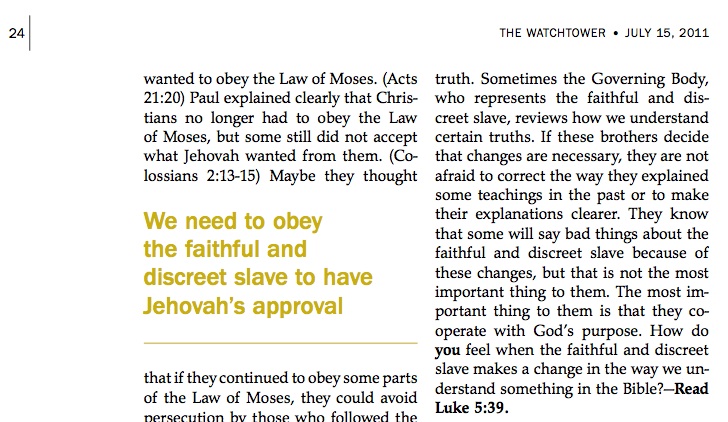
"We need to obey the faithful and discreet slave to have Jehovah’s approval." Watchtower 2011 Jul 15 p.24 Simplified English Edition

"Since Jehovah God and Jesus Christ completely trust the faithful and discreet slave, should we not do the same?" Watchtower 2009 Feb 15 p.27

"[A mature christian] does not advocate or insist on personal opinions or harbor private ideas when it comes to Bible understanding. Rather, he has complete confidence in the truth as it is revealed by Jehovah God through his Son, Jesus Christ, and "the faithful and discreet slave." Watchtower 2001 Aug 1 p.14
"But Jehovah God has also provided his visible organization, his "faithful and discreet slave", made up of spirit-anointed ones, to help Christians in all nations to understand and apply properly the Bible in their lives. Unless we are in touch with this channel of communication that God is using, we will not progress along the road to life, no matter how much Bible reading we do." Watchtower 1981 Dec 1 p.27
"... show respect for the “faithful and discreet slave” that He is using at the present time. Actually, your very life depends on following this course of action. Remember, too, it is only he that endures to the end that will be saved." Watchtower 1964 Jul 15 p.435
"To act consistently with our baptism for life and into the Greater Noah we must submit to and cooperate with that slave and its legal instrument, the Watch Tower Society." Watchtower 1959 Oct 1 p.583
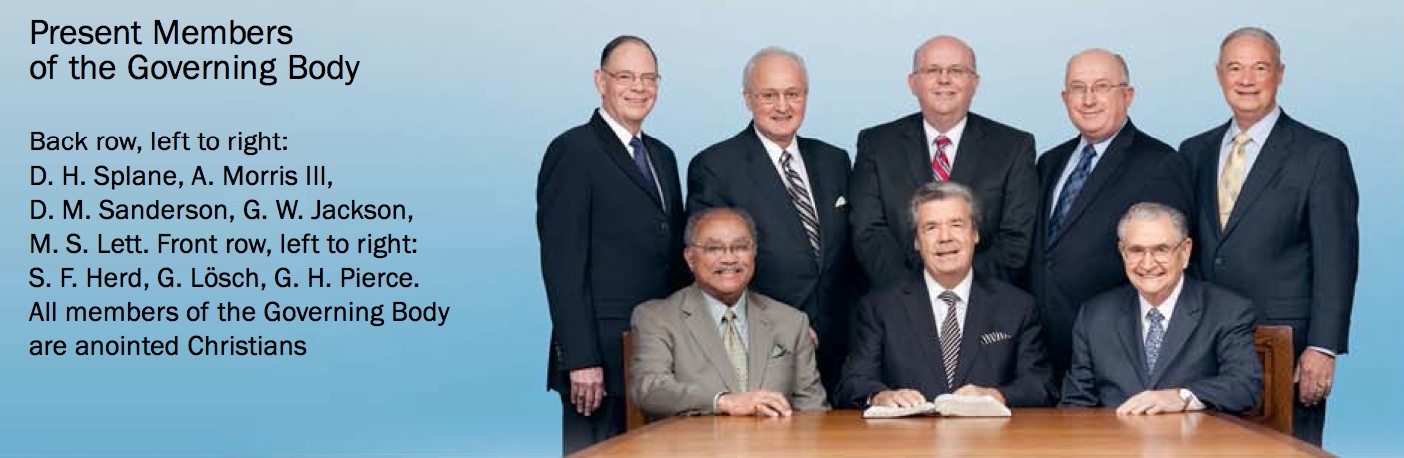
Image source: Watchtower 2013 Jul 15 p.26
Jehovah's Witnesses are told they must follow all instructions they receive from the faithful and discreet slave, regardless of whether they seem to be "unsound," "strange, impractical or illogical."
"How will we be helped if we learn to trust in Jehovah and his representatives? Now is the time to learn to trust in God’s way of doing things by not second-guessing the direction and the decisions of the elders. When the great tribulation strikes, we will be ready to obey even if we receive instructions that seem strange or illogical.—w22.02, pp. 4-6." Watchtower 2022 Dec 15 p.15
"As the end of this system of things draws near, we need to trust in Jehovah’s way of doing things as never before. Why? During the great tribulation, we may receive instructions that seem strange, impractical, or illogical." Watchtower Feb 2022 p.6
"All of us must be ready to obey any instructions we may receive, whether these appear sound from a strategic or human standpoint or not." Watchtower 2013 Nov 15 p.20
The expectation the Governing Body has of its followers is frightening, since their teachings affect what Jehovah's Witnesses believe regarding doctrine, morals, history and the future.
In July 2026 the Morning Worship "Faithfully Obey in What is Least" emphasised that the Governing Body must be followed regardless of how illogical, dangerous, strange, or impractical their instruction may seem. It created a parallel with Moses and the 10 plagues.
"Well, our scripture text for today along with the Watchtower comments indicate that our obedience in small matters may actually affect our survival during the coming great tribulation. Note however other similar comments from Watchtower’s over the years. For example, December 2007 says, "As we get nearer to the outbreak of the great tribulation, we may well receive some detailed instructions. Our safe journey through those troublesome days will depend on our keeping in step with other loyal servants of Jehovah."
March 2022. At times the slave may give direction that we do not fully understand. For example, we may receive specific instructions for surviving a natural disaster that we think is unlikely to occur in our area.
October 2023 Watchtower during the early part of the Covid 19 pandemic when we were asked to stop meeting at our kingdom halls and to suspend our house-to-house ministry. Did you struggle to obey? Yet your obedience protected you, united you with your fellow believers, and pleased Jehovah. All of us are now better prepared to obey any instructions we receive during the great tribulation.
And finally, Watchtower, February of 2024. We might occasionally find it a challenge to follow Jehovah's guidance, especially when it is conveyed by imperfect men. Why? The council may conflict with our likes or dislikes. Or we might feel that the direction is unwise and that the council must not be from Jehovah. So, as we can see, the Watchtower in recent years has repeatedly reminded us to obey. Even though, as today's Watchtower comments indicate, we may receive instructions that seem strange, impractical, or even illogical.
Why? Well, let's go back in time to ancient Egypt at the time when the Israelites were delivered. Do you remember any instructions at that time that could have seemed strange, impractical, or even illogical?
…
Now, after their departure from Egypt, Jehovah told Moses to have the Israelites turn back and camp up against the Red Sea. Now, they were trapped between the Red Sea and Pharaoh's oncoming war chariots. Seem illogical, dangerous, or brilliant? You know the answer.
So today the lessons, what if we receive instructions from Jehovah's organization that at first seem ineffective? Maybe these instructions seem to make our life even harder, as when Israel had to find straw in addition to making bricks. Or what if the instructions we receive uh seem overly intrusive into our personal lives, personal decisions, such as what we eat, how to cook it, and even how we eat it. Or what if we don't understand the reasons for certain instructions for days or weeks or months or even another 1,500 years? Or what if instructions from Jehovah's organization seem to put us in danger as when Israel appeared to be trapped at the Red Sea? What will help us to obey? Well, we have to remember this. With each plague, Jehovah repeatedly showed he was using Moses and Aaron. And has he not done so today? Think how during these difficult last days through disasters and wars and pandemics, we have repeatedly been guided by wise direction from Jehovah's organization, the faithful and discrete slave.
The lesson. Now's the time to train ourselves to trust Jehovah, trust those whom he is using and faithfully obey even in little things. Doing so prepares us not just for the great tribulation but for the days ahead even during the thousand-year reign according to Psalm 45 and verse 16.
So, will we keep following direction even when it means setting aside personal preferences? That depends on how we respond to the guidance Jehovah is providing." Jonathan Smith "Faithfully Obey in What is Least" July 2026
Comparing the Governing Body to Moses doesn't follow, as the Governing Body have never presented any miracles, whilst the account of Moses includes numerous, including parting the Red Sea. The closest that could be conjured is the guidance provided by the Governing Body during Covid, which was a simple reiteration of general health guidance to isolate and vaccinate.
Since the Governing Body wields such grandiose and all-encompassing power, it is important to examine whether there is proof that Watchtower leaders are being used by Jehovah.
Proof
In Bible times, Jehovah made it simple to recognise those he had chosen to lead his people through the use of miracles and gifts of the spirit. Watchtower leaders demonstrate none of these indicators.
| Identifying those used by Jehovah | ||
|
|
|
|
| Miracles |
Jehovah used miraculous works to identify those chosen to lead others. For example:
Noah - Gathering of the animals Moses - Staff into a snake Apostles - Gifts of the spirit, such as faith healing |
None |
| Prophecy | When Jehovah used a person to make future predictions, the prophecies were always correct. For example, Daniel's prophecy for the fall of Babylon and the line of world powers |
100% of Watchtower predictions have been false, such as that the end of the world would be in 1914, then 1925, then 1975. Furthermore, the generation teaching promoted prior to 1995 is about to be proven false, as the last survivors born prior to 1914 die out. |
| Consistency |
Bible is harmonious, with Bible writers presenting a message without contradiction. |
Watchtower doctrine has been in constant flux. This cannot be explained as new light, as there have been numerous flip flops and contradictions, such as the generation teaching, organ transplants, and superior authorities. |
As the Watchtower is without clear and visible proof of God's backing, it resorts to unsubstantiated claims of guidance, devoid of any legitimate basis.
"OVERWHELMING CREDENTIALS
The "faithful and discreet slave" has abundant credentials. Following is a partial list of Scriptural and prophetic designations applying to or being represented in the remnant of Jesus Christ's anointed followers since the notable year 1919:" Watchtower 1981 Mar 1 p.27
The 1981 article follows with a list of 80 "prophetic designations" that the reader is expected to believe foreshadow the modern day slave, including Bible accounts as diverse as "Noah's wife", "Angels sent to Lot" and the "Gleaning left behind". Can these accounts seriously be considered proof that the Watchtower leaders represent the Slave since 1919?
This concept became even more ironic when the Watchtower 2013 Jul 15 pp.22,25 stated the Faithful Slave were not been appointed over all Jesus belongings. In 1919, they were appointed over the domestics, but the appointment over all his belongings does not take place until after the Great Tribulation. The "foremost" reason the Slave was demanding trust ceased to exist.
Another line of reasoning is that "mature" Christians will realise that Watchtower is guided by Jehovah, due to superiority of doctrine, displays of love and growth in membership.
"Those mature in Christian growth have, through the Scriptures and the evident manifestation of Jehovah's favor on his faithful and discreet slave, come to appreciate that Jehovah deals with his people as an organization and that his spirit operates in conjunction with that organization. (Matthew 24:45-47)" Watchtower 1958 May 1 p.285
"The abundance of spiritual food and the amazing details of Jehovah's purposes that have been revealed to Jehovah's anointed witnesses are clear evidence that they are the ones mentioned by Jesus when he foretold a "faithful and discreet slave" class" Watchtower 1964 Jun 15 p.365
Is self proclamation of being the Slave proof that this is so? Every religion believes they have Scriptural backing for their beliefs and can point to membership numbers as evidence of God's favour.
The Governing Body do not display consistency of teachings, having been required to present ongoing changes to doctrine. They have a 100% failure rate for their prophecies or predictions for the timing of the world's end. Neither are they able to perform miracles. There is no proof of their being God's spokesmen, or that they are being used by him.
Who Does the Parable refer to?
Is it apparent that the faithful slave is the Governing Body? No, as shown by Watchtower changing its teaching on who the Faithful Slave is several times. For a detailed article on these changes see Faithful & Discreet Slave Changes.

Is it clear that the faithful slave was chosen in 1919. The article How 1919 is Derived shows that there is no justification for 1919 having any significance.
For many decades, Watchtower taught that the faithful and discreet slave included all 144,000 "anointed" Jehovah's Witnesses. It wasn't until the 2012 Annual Meeting that the Governing Body greatly increased their own authority by announcing that they alone represented the faithful and discreet slave.
Originally, Russell said the Slave was an illustration of the entire body of Christ, the little flock of 144,000 heavenly rulers.
The Slave was described as the little flock - the 144,000 - extending from the time of Jesus.
"Over a period of more than 1,960 years, that work of education has continued, preparing a little flock made up of people from "every tribe and tongue and people and nation" to serve with Christ in his heavenly Kingdom." Yearbook 1996 p.3
In 1981, anyone that felt the Slave did not include all the 144,000 were vilified as objectors who were trying to force an interpretation.
"The objectors may argue that not all of Christ's anointed disciples have a share in preparing the spiritual food, so that perhaps the "slave" pictures only the leading ones, and the "domestics" those they serve in the congregation.
There is no point in trying to force an interpretation of the parable. Self-deception is of no benefit and is spiritually damaging. ... Thus we see a clear Scriptural basis for saying that all anointed followers of Christ Jesus make up God's "servant," with Jesus as its Master." Watchtower 1981 Mar 1 pp.24-26
In 2012, the Governing Body completely contradicted itself with the new claim that they alone represent the Faithful Slave.
""Who Really Is the Faithful and Discreet Slave?"
... From 1919 on, there has always been a small group of anointed Christians at the world headquarters of Jehovah’s Witnesses. They have supervised our worldwide preaching work and have been directly involved in preparing and dispensing spiritual food. In recent years, that group has been closely identified with the Governing Body of Jehovah’s Witnesses." 2012 Annual meeting jw.org 10th Nov 2012.
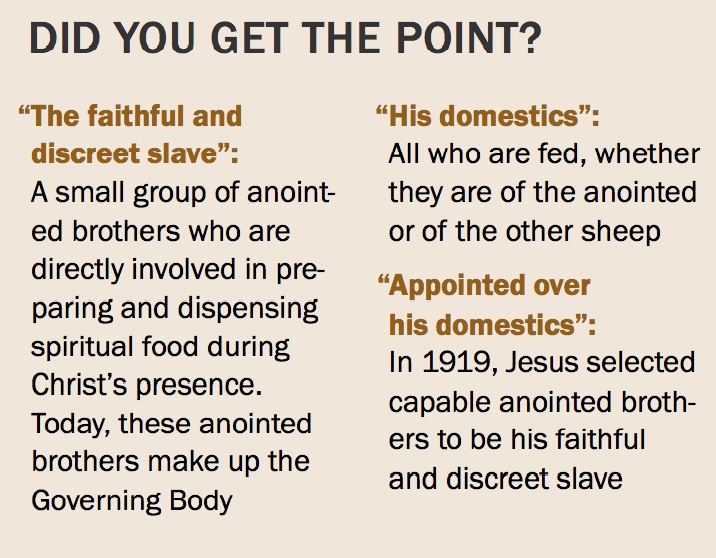
Image source: Watchtower 2013 Jul 15 p.22
The reason Watchtower has been so flexible in how it interprets this parable is by completely ignoring the Scriptural context.
Watchtower turns a parable into a prophecy
Jesus provided a story about a faithful slave, with the intention to invoke good behaviour in his followers, not as a prophesy about a group of leaders 2000 years in the future.
The parable is a reference to Potiphar's servant Joseph.
Genesis 39:4-6 "Joseph kept finding favor in his eyes, and he became his personal attendant. So he appointed him over his house, and he put him in charge of all that was his. From the time he appointed him over his house and in charge of all that was his, Jehovah kept blessing the house of the Egyptian because of Joseph, and Jehovah’s blessing came to be on all that he had in the house and in the field. He eventually left everything that was his in Joseph’s care, and he gave no thought to anything except the food he was eating."
Luke 12:42-46 parallels the account of Joseph in vocabulary and story line. Potiphar was absent, during which time Joseph faithfully avoided his wife's advances, until "his master came to his house." (Genesis 39:16) Eventually, Joseph was blessed and appointed over all Pharaoh's belongings when he came to be in charge of supplying the rations of grain during Egypt's time of famine.
As such, the parable was intended as a positive example that all could benefit from. In particular, it is aimed at congregational ministers, which is the common Christian understanding of this story.
"Some state that the "slave" refers to Christian ministers, or their office of oversight, with responsibility to care for the spiritual needs of the congregation. The 'master's' arrival is said to be either the second coming of Christ or the death of the individual minister. Thus it is held that the parable should motivate Christian ministers to care well for what is entrusted to them." Watchtower 1981 Mar 1 p.24
Circular Reasoning
The Governing Body say they are trustworthy because Jesus has appointed them.
"There are many reasons to have complete trust in the slave class. First and foremost, Jesus has appointed them over all his precious "belongings." This is a clear indication that he has complete trust in them." Organized to Do Jehovah's Will (2005) p.18
In the video "In Whom Do You Trust?" Mar 2018, Gerrit Lösch declared:
"This is not to say that the slave is perfect, and never make mistakes, but Jehovah and Jesus trust the imperfect slave who cares for things to the best of his ability and with best of motives. Shouldn't we then trust the imperfect slave as well? To appreciate the extent of Jehovah's and Jesus' trust in the faithful slave, reflect on what he has promised its members, he has promised them immortality and incorruption." jwb.201803-2.v 14:15
The following is a copy of notes taken in a 2017 pioneer school.
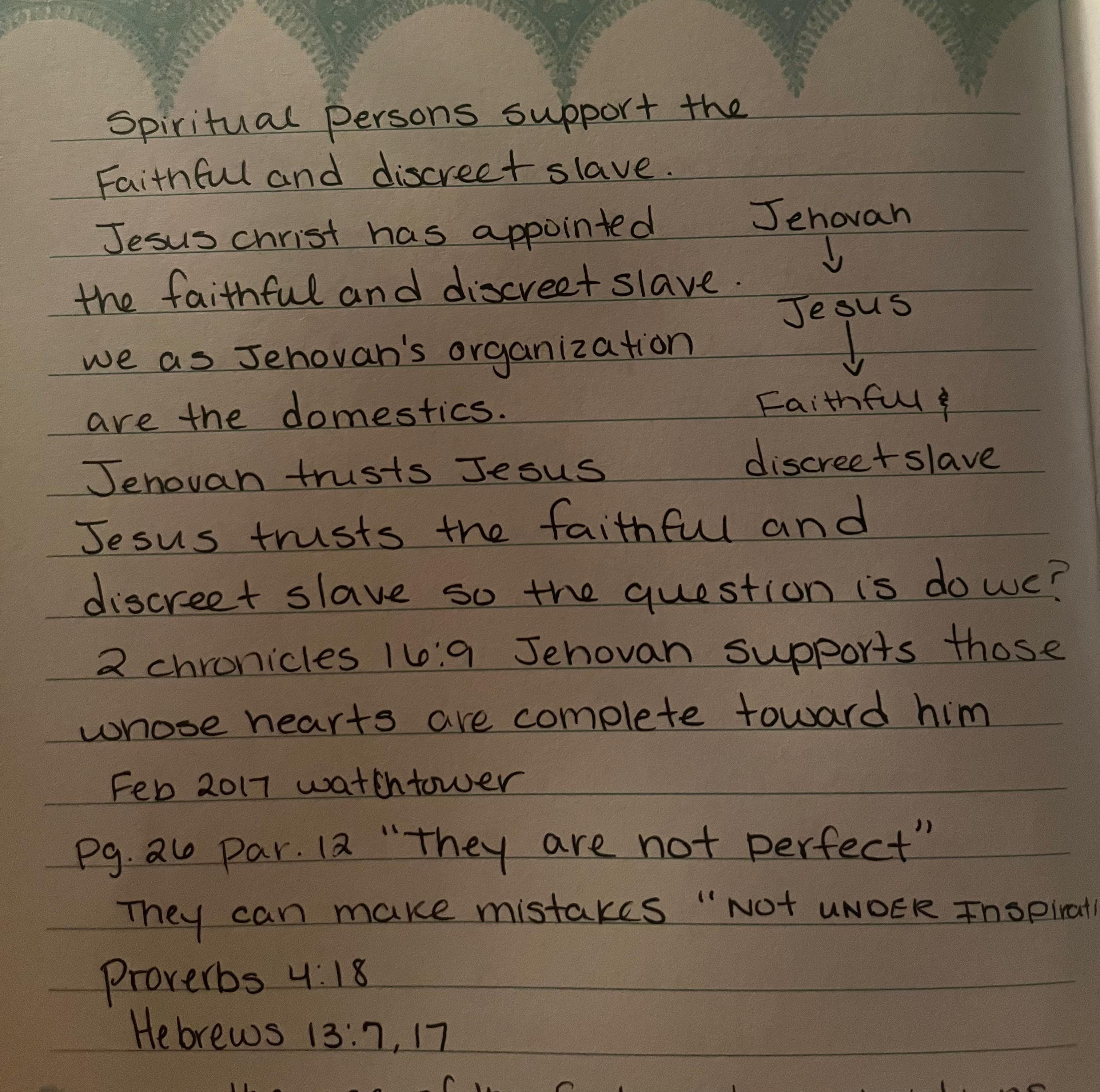
These notes and Watchtower quotes can be summarised as follows:
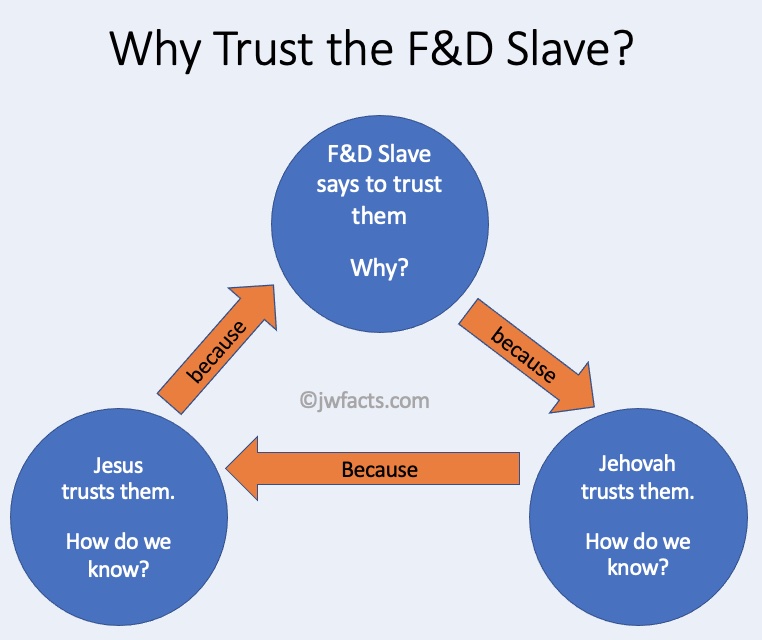
This is a classic example of circular reasoning - "Since we tell you that Jesus trusts us, you can trust us."
Consequences
The Governing Body have bestowed great importance upon themselves, such as this image of government officials discussing them personally.

JW Broadcasting - May 2024
The defining concept to being a Jehovah's Witness is not worship of Jehovah, but rather following the "faithful and discreet slave." In a judicial committee, the foremost question is not whether a Witness believes the Bible or worships Jehovah, but whether they believe Jehovah is using Watchtower's Faithful and Discreet Slave. If a person believes in the Bible and Jehovah, they will still be disfellowshipped as an apostate if they openly confess that the Watchtower Governing Body do not represent Jehovah's slave.
The Governing Body has managed to deflect attention from Jesus by means of their doctrine that Jesus is mediator for the Slave class alone, and that salvation can only be achieved through association with the Slave.
"He is the Mediator between his heavenly Father, Jehovah God, and the nation of spiritual Israel, which is limited to only 144,000 members. " Worldwide Security Under the "Prince of Peace" (1986) pp.10-11
Rather than draw people to Jesus, the Governing Body misapply the parable of the Faithful and Discreet Slave to direct attention to themselves, inserting their authority between Jesus and his followers.
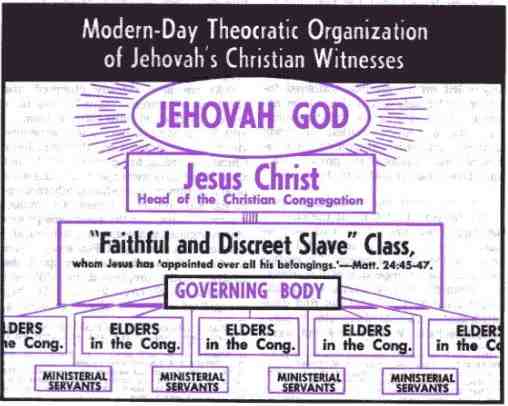
Watchtower 1971 Dec 15 page 749
The Watchtower 2013 April 15 does not include Jesus at all in an image depicting the hierarchy of their Organisation Chart. This no longer references Jesus or the Anointed, nor separates the Governing Body from the Faithful Slave, but extends from Jehovah directly to the Governing Body, Branch Committees, Travelling Overseers, Elders, Congregations and finally Publishers.
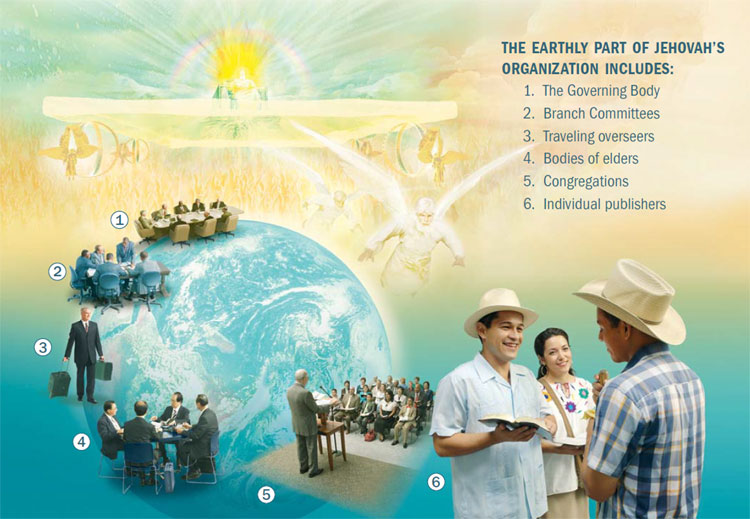
Watchtower 2013 Apr 15 page 29
Unusually for a Christian religion, they have chosen this representation, which does not include Jesus at all, but has the Governing Body directly beneath Jehovah. The image draws on the Celestial Chariot of Ezekiel 1 as a basis for the heavenly part of the Organisation. There is no reason why they could not have used Daniel 7, which the same Watchtower also references, which has Jehovah's Throne on wheels, along with the Son of Man. They could then include Jesus as part of their organizational structure, as surely Jesus is the most important part of any Christian organization.
In the April 2023 morning worship program, the Governing Body were likened to the "voice of Jesus."
"The Governing Body could be likened to the voice of Jesus, the head of the congregation. So when we willingly submit to the faithful slave, we're ultimately submitting to Jesus' authority and direction."Kenneth Flodin: ‘Jesus’ Yoke Is Kindly’ jwb-095-10.v 3:28 min
This is reminiscent of a quote by Jesus.
Luke 21:8 "Watch out that you are not deceived. For many will come in my name claiming, 'I am he,' and 'The time is near.' Do not follow them."
Claiming to be the voice of Jesus and also Jehovah, the Governing Body push for placid compliance.
"To obey is better than a sacrifice.-1 Sam. 15:22. If organizational changes test your loyalty, what should you do? Fully support the organizational changes. ... Jehovah values your obedience far more than any assignment." Examining the Scriptures Daily—2024 Wednesday, Dec 25 pp.126-127
"And when Jehovah’s organization makes changes that affect you personally, wholeheartedly accept them and obey the direction." Watchtower 2022 Nov p.25
The Governing Body use the Slave concept to say that without them the Bible is beyond understanding.
"However, we cannot hope to acquire a good relationship with Jehovah if we ignore those whom Jesus has appointed to care for his belongings. Without the assistance of “the faithful and discreet slave,” we would neither understand the full import of what we read in God’s Word nor know how to apply it." Examining the Scriptures Daily 2012 Mar 4
"All who want to understand the Bible should appreciate that the "greatly diversified wisdom of God" can become known only through Jehovah's channel of communication, the faithful and discreet slave" Watchtower 1994 Oct 1 p.8
"We have the opportunity to show love for our brothers who take the lead in the congregation or in connection with Jehovah's visible organization worldwide. This includes being loyal to "the faithful and discreet slave." (Matthew 24:45-47) Let us face the fact that no matter how much Bible reading we have done, we would never have learned the truth on our own. We would not have discovered the truth regarding Jehovah, his purposes and attributes, the meaning and importance of his name, the Kingdom, Jesus' ransom, the difference between God's organization and Satan's, nor why God has permitted wickedness." Watchtower 1990 Dec 1 p.19
"Thus the Bible is an organizational book and belongs to the Christian congregation as an organization, not to individuals, regardless of how sincerely they may believe that they can interpret the Bible. For this reason the Bible cannot be properly understood without Jehovah's visible organization in mind." Watchtower 1967 Oct 1 p.587
The Bible has been provided for people to know God's requirements. Has the Watchtower enlightened people beyond the words of Jesus? Is it not more accurate to say that what the Watchtower has said beyond that contained in the Bible has regularly been wrong and later changed? Information such as:
- Failed time prophecies
- Strange medical information and dangerous decrees such as that vaccinations and transplants are unchristian
- The changing stance on blood
Tens of thousands of Jehovah's Witnesses have died refusing blood transfusions, yet over the years the Governing Body have rolled back their stance on blood.
In 2026, the rule that a person's own blood could not be stored for a transfusion was overruled.
"Therefore, after much prayer and consideration of the Scriptures, the Governing Body has decided to clarify our position on the use of a patient’s own blood in medical and surgical care. The clarification is this: Each Christian must decide for himself how his own blood will be used in all medical and surgical care. This includes whether to allow his own blood to be removed, stored, and then given back to him." Governing Body Update #2, March 2026
How many Jehovah's Witnesses needlessly died prior to this change? Rather than take accountability or apologise, in the July 2026 Morning Worship "Faithfully Obey in What is Least" Jonathan Smith reiterated blind obedience.
"So, as we can see, the Watchtower in recent years has repeatedly reminded us to obey. Even though, as today's Watchtower comments indicate, we may receive instructions that seem strange, impractical, or even illogical." Jonathan Smith "Faithfully Obey in What is Least" July 2026
By going beyond the guidelines given in the Scriptures on removing/disfellowshipping, the Governing Body have created a practice that has had a destructive effect on the lives of hundreds of thousands of people, dividing families for decades?
Watchtower likens disobeying its leadership and rules to the rebellious Israelites that were struck dead by Jehovah for criticizing Moses.
"By criticizing Moses, the rebels were really criticizing Jehovah. They did not focus on what Jehovah wanted; they focused on what they wanted—more power and recognition. God struck down the leaders of the rebellion as well as thousands more who sympathized with them. (Num. 16:30-35, 41, 49) Today we can be sure that Jehovah disapproves of those who disrespect his organizational arrangements. (Question 11. What happened to those in ancient Israel who challenged God’s choice of Moses as the one taking the lead?)" Watchtower 2024 July p.11
Can the Governing Body liken themselves to Moses? Moses performed miracles, such as turning his staff into a serpent and parting the red sea.
The irony of likening the Governing Body to Moses is that Jehovah punished Moses and forbade him from entering the promised land, because Moses took glory for himself that belonged solely to Jehovah.
Deuteronomy 32:50-52 "Then you will die on the mountain you are about to ascend, and be gathered to your people, just as Aaron your brother died on Mount Hor and was gathered to his people, because both of you were unfaithful to me among the Israelites at the waters of Merʹi·bah of Kaʹdesh in the wilderness of Zin, because you did not sanctify me before the people of Israel. You will see the land from a distance, but you will not enter the land that I am giving to the people of Israel.”
When a group of men claim special guidance from God as his sole representatives, they risk controlling people without justification, leading to disastrous results for the followers.
"Do not put YOUR trust in nobles, Nor in the son of earthling man, to whom no salvation belongs." Psalms 146:3
Watchtower warns against trusting in men, such as the article "Is Your Trust in God... or in a Man?" Watchtower May 15 1979 p.3
It is hypocritical, even terrifying, to hear Lett tell followers the Governing Body, a group of men, should be followed without any consideration for the logic of what they say.
"So our obedience to direction from Jehovah’s organization should not be dependent on whether we understand or even agree, but we spontaneously obey from the heart." M. Stephen Lett: Jehovah Alone Is Wise (Rom. 16:27) 2026 jwbvod25-49.v
Christians do well to keep in mind Bible warnings about following humans, and remember who their head really is.
Written July 2006, latest update July 2026.
 Paul Grundy 2005 - 2026