
home > interesting topics > where else
Where Else Would I Go?
“In the long run it is far more dangerous to adhere to illusion than to face what the actual fact is.” Physicist David Bohm
The first question a Jehovah's Witness will ask when confronted with the truthfulness of Watchtower teachings is:
“Where else would I go?”
This question is a "thought stopping" technique. It may appear valid, but at the time of questioning it is a mental diversion from the issue being discussed. Fear of what will come next is used to deflect from the question of whether Watchtower teaches the Truth. "Where else to go" is of no relevance until there is a thorough understanding of the more important question;
Does the Watchtower teach the truth?
Fear should not prevent an honest evaluation of the facts about Watchtower teachings. It is only once convinced that Watchtower does not teach truth that a person can legitimately address - "Where else can I go?"
This question is not unique to Jehovah's Witnesses, and common to members of high control groups. Mormons, Seventh-day Adventists and Worldwide Church of God echo this identical sentiment. (See sites such as ex-sda.com and exmormon.org)
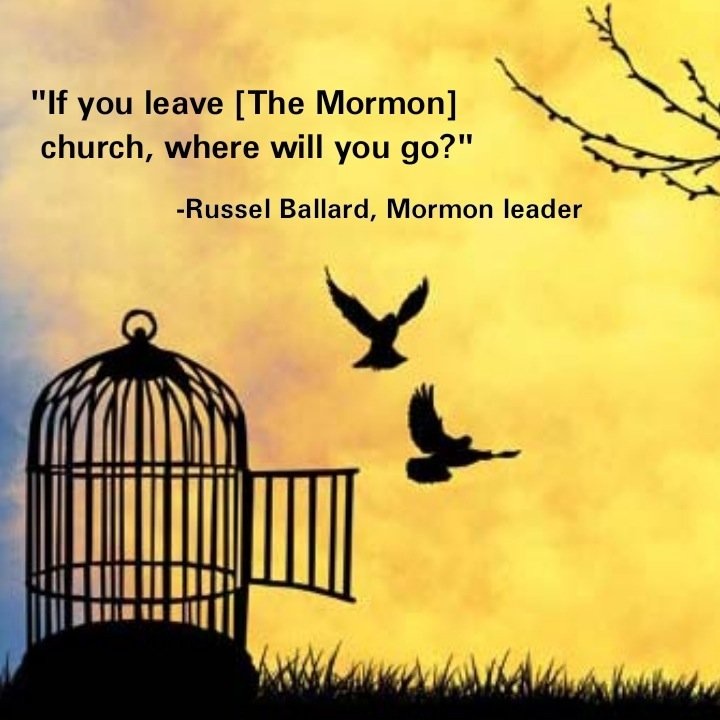
Steven Hassan refers to this as Phobia Indoctrination, saying "members are systematically made to be phobic about ever leaving the group." 1 This fear is reason for the success high control groups have in keeping their members from facing the truth about their religion.
This article is not intended to promote a particular religion or belief structure. Rather it discusses the errant concept of a single true organization and the different directions former Jehovah's Witnesses take upon leaving Watchtower. What follows is written predominantly from a Christian perspective.
Where or Whom?
Watchtower encourages the question of "where to go" by misapplication of Scripture. Ask one of Jehovah's Witness what Peter said when Jesus asked if Peter would leave him. The answer will invariably be that Peter responded, "where would I go?", as this is how his words are quoted in the Watchtower.
"Where could we turn if we would leave God's organization today? There is nowhere else! (John 6:66-69)" Watchtower 1975 Sep 1 p.531
"Furthermore, suppose a person was to separate himself from Jehovah's people. Where could he go? Is he not faced with the same issue that confronted Jesus" apostles when he asked them if they also wanted to leave him? The apostle Peter rightly replied: "Lord, whom shall we go away to? You have sayings of everlasting life." (John 6:68) There is nowhere else to go but to "Babylon the Great," the world empire of false religion, or into the clutches of Satan"s political "wild beast." (Revelation 13:1; 18:1-5) Largely, disloyal ones who have left Jehovah's visible organization have made common cause with those in God-dishonoring ">Babylon the Great." Watchtower 1988 Mar 15 pp.18-19
At John 6:68 Peter did not ask Jesus "where" but rather "Lord, whom shall we go away to?" This is the essence of Christianity; it is not about an organization but about being a follower of Jesus.
Galatians 3:29 "Moreover, if YOU belong to Christ, YOU are really Abraham"s seed, heirs with reference to a promise."
John 8:32, 36 "You will know the truth and the truth will set you free."
Christian freedom comes from belonging to Jesus, not an organization; otherwise a person is no freer than the Israelites that were enslaved to the legislation of the Pharisees.
Likewise, salvation is only through Jesus;
John 10:9 "I am the door; whoever enters through me will be saved, and he will go in and out and find pasturage."
Acts 4:12 "Furthermore, there is no salvation in anyone else, for there is not another name under heaven that has been given among men by which we must get saved."
Acts 16:31 "Believe on the Lord Jesus and you will get saved, you and your household"
2 Timothy 2:10 "that they too may obtain the salvation that is in union with Christ Jesus along with everlasting glory."
What is Truth?
Jehovah's Witnesses believe there is an absolute truth and that Watchtower represents it more accurately than anyone else.
"Brother Schroeder highlighted the confidence Jehovah's people have because their faith is based on absolutes. They know, for example, that Jehovah is the Universal Sovereign and that his Word, the Holy Bible, is absolute truth." Watchtower 1987 Dec 1 p.22
Believing the Watchtower version of this absolute truth is thought to be essential if a person does not wish to be destroyed at Armageddon.
"This means everlasting life, their taking in knowledge of you, the only true God, and of the one whom you sent forth, Jesus Christ." (John 17:3) That is one of the scriptures most widely used by Jehovah's Witnesses to help others appreciate the importance of studying God"s Word. It is certainly no less important for each one of us to do so personally. Our very hope of living forever is contingent on our growing in knowledge of Jehovah and his Son, Jesus Christ." Watchtower 2000 Oct 1 p.23
The idea that there is absolute truth is sound, what the Watchtower fails to acknowledge is that it is impossible for humans to know absolute truth. If following absolute truth is the criteria for being acceptable to God the Watchtower precludes itself, due to the ongoing doctrinal errors and changes. To say that any one particular Christian group has a special key to "truth" has no Scriptural backing, and to search tens of thousands of religions is not only impossible but pointless, as no other religion teaches absolute truth either. Such a search is fraught with disappointment.
Why does a person need a concrete belief structure? Faith is the belief in what is unproven and by definition the very reason no one can prove a complete "truth", so why insist on demanding one? What is the answer? It is not doctrine; in fact Jesus rarely discussed doctrine. It is not an organisation; Jesus never mentioned an organisation. The Bible shows that Christ is "truth". The Bible message is to follow and recognise him as the means for salvation.
Organization
The fundamental premise of being one of Jehovah's Witnesses is that worship of God requires an intermediary organization. This is so consistently enforced into the minds of a Jehovah's Witnesses that even when they learn that the Watchtower Society does not teach truth it is common to feel the need to fill the void with a similar organization. This feeling is simply due to the amount of emphasis the Watchtower Society places on being part of an organization. Even though the Bible never uses the word organization, between 1950 and 2003 the word organization occurs 10,466 times in the Watchtower magazine alone, an average of over 7 times per issue. Even when the heart knows it is not The Truth, remnants of Watchtower thinking can deceive a person into believing that an organization is needed and there is nothing better than the Watchtower Society.
The word organization does not appear in the Bible. For the first 2,500 years of human history there was no single organization and worship was not contingent on membership of a church. Yet we have records of the most God fearing men of all time; people such as Enoch, Joseph, Noah and Abraham. The Watchtower teaches that Oriental Job served God after the formation of the nation of Israel. Though he had no ties to this group God said that there was "no one like him in the earth" (Job 1:8)
In Christian times Jesus promised to be with his followers at all times providing individual sustenance and guidance through the Holy Spirit.
Matthew 28:20 "Look! I am with you all the days until the conclusion of the system of things."
1 Corinthians 6:19 "What! Do YOU not know that the body of YOU people is [the] temple of the holy spirit within YOU, which YOU have from God?"
(See also Acts 1:8; Acts 2:38; Acts 16:6; Romans 8:26-27)
When the Samaritan woman asked where to worship, Jesus showed a physical place is not important, answering;
John 4:23 "Nevertheless, the hour is coming, and it is now, when the true worshipers will worship the Father with spirit and truth, for, indeed, the Father is looking for suchlike ones to worship him."
A person can rightfully worship alone or in small groups. Jesus promised that he would direct his followers no matter how many were gathered together.
Matthew 18:20 "Where there are two or three gathered together in my name, there I am in their midst!"
Meeting together to discuss things of a spiritual nature with friends over a meal or coffee can be enjoyable; the input from others affords a balanced view and can be more encouraging than being lectured from a pulpit.
The social nature of humans fills people with the need to belong to a community. This is not God's need, but man's. A church is not essential for worship, but this is not to indicate that they are of no benefit, or that large gatherings are wrong. Jews had large festivals and would meet at the temple. Jesus spoke to 3,000 non believers on a mountain. Peter spoke to a large gathering after which 3,000 were baptized. Groups were formed by early Christians, "that the congregation may receive upbuilding". (1 Cor 14:5) Christian congregations met in houses with like minded people worshipping Christ. As traditionally common in society, mature members guided the newer ones. (Acts 20:28)
The formation of congregations indicates order, but it does not imply an organization that demands unquestioning obedience. There was freedom to discuss different points of view without fear of retribution, such as when congregations disagreed over circumcision. When such serious disagreement arose a large group of older men came to consensus, the consensus was not to "further burden" the congregation. (Acts 15:28)
What now?
Worship is about faith in God, so what is the reason for belonging to a religious organization? It may be for teaching and ritual but in large part it is for fellowship. In seeking a group to worship with, one of the most important things to remember is that you have freedom of choice. Find the group most suitable for assisting you in that worship.
Researching other religions can help a Jehovah's Witness move on from the experiences of the past and the continual rerun of Watchtower doctrine in ones mind. This is better than staying alone trying to create the correct version of Watchtower truth, or creating a philosophy based solely on a negative Jehovah's Witness experience. In the process of meeting with others, sharing your Witness experience can also be helpful to them.
People generally join Jehovah's Witnesses during an emotionally vulnerable period, attracted to the promise of friends and the message of living forever in paradise. If they wish it to be true, they see it as true, despite the doctrinal and historical flaws. It is unfortunate that these promises are just bait. Once hooked, high control religions such as Watchtower manipulate such people by convincing them they are worthless sinners if they do not strictly adhere to their interpretation of Christianity. Your experience should leave you better prepared to avoid such tactics from other groups, and it is important to be able to recognise the criteria that identify groups using coercive persuasion.
With over 10,000 religious groups and 30,000 Christian sects globally it is impossible to examine a fraction of these and illogical to think there is a single correct religion. No group knows or teaches absolute truth, so it is advisable to steer clear of any group whose leaders attempt to take intimate control of your life and opinions, taking away your basic human rights and freedom. Finding the right one for you is personal choice. The overall mentality of the Church matters more than individual doctrines. Are the people friendly, accepting, reasonable and helpful? One of the glories of Christianity is the variety, revel in it. The New Testament does not give long lists of regulations, it gives principles. You can now apply these uniquely based on your individual circumstances and culture around you.
Even the original purpose of Watchtower was not to be a isolationist and controlling sect. Russell stated Bible Students were not to be identified by a sectarian name but simply as Christians.
"We always refuse to be called by any other name than that of our Head --Christians--continually claiming that their can be no division among those continually led by his Spirit and example as made known through his Word." Zion"s Watch Tower 1883 Mar p.6
Together they would meet to discuss the Bible. Love was to be the identifying factor rather than intricate doctrinal unity. Russell recognized that forced doctrinal unity was the source of apostasy and bondage.
"The endeavor to compel all men to think alike on all subjects, culminated in the great apostasy; The union of the early church, based upon the simple gospel and bound only by love, gave place to the bondage of the Church of Rome a slavery of God's children, from the degradation of which multitudes are still weak and suffering" Zion's Watch Tower 1893 Sep p.264
This type of mentality is healthier than the concept of strict reliance on an organization demanding unquestioning allegiance. After the end failed to arrive as predicted in 1925, Rutherford restructured the concepts of doctrine and organization. The command of Matthew 28:19 to "make disciples" no longer meant to make Disciples of Christ, but rather followers of Rutherford's organization. William J Schell writes about the transition from Christ to organization in 30 Years a Watchtower Slave Abridged Edition 2001. He explains that beginning 1926;
"No longer, as in the old Bible Student days were we following the command of Jesus in Matthew 28:19-20 to disciple the nations for Christ, to become Christians. They had better get in with us as God's Organization or suffer the consequences which would automatically accrue to Satan's organization in Armageddon!" (p.69) "Home Bible study was discontinued for Book studies, with the Societies books and textbooks in place of the Bible, and the Bible relegated to a position where it was restricted almost exclusively to reference use." (p.101)
In The Myth of Certainty: The Reflective Christian; the Risk of Commitment [2] Professor Daniel Taylor warns that this transition is common:
"The primary goal of all institutions and subcultures is self-preservation. Preserving the faith is central to God"s plan for human history; preserving particular religious institutions is not. Do not expect those who run the institutions to be sensitive to the difference. God needs no particular person, church, denomination, creed or organization to accomplish his purpose.
Nonetheless, questioning the institutions is synonymous, for many, with attacking God; something not long to be tolerated. Supposedly they are protecting God . . . Actually, they are protecting themselves, their view of the world, and their sense of security. This threat is often met, or suppressed even before it arises, with power. . . Institutions express their power most clearly by enunciating, interpreting and enforcing the rules of the subculture."
Professor Taylor's comments help explain why religions can become oppressive to the point of excommunication, war or crusade. If choosing a new church, speak to members and former members and research both sides of the story, such as on the Internet. Compare what you find with the eight attributes Lifton specified identify indicate mind control. Many religious groups display high control and this is normally a good indication that they are worth avoiding. If a religion does not feel right to you it probably isn't right for you.
If a religion is strictly regimented and intolerant of others it is going beyond the Scriptures. Jesus warned against those that "teach commands of men as doctrines." (Matthew 15:9) When the leaders of a religious group are not to be questioned an unhealthy form of worship results. There are estimated to be more than 3,000 cults in America alone that fit this description. Larger organizations that promote this type of unhealthy worship are usually not referred to as cults but as high control groups. Generally in these groups shunning is the result of failing to comply with the leaders demands. This includes Jehovah's Witnesses, Mormons and some evangelical Born Again groups. Catholics have a similar structure but in modern times have become less rigid in enforcing these rules.
Which denomination for Former Jehovah's Witnesses?
It is comforting as one of Jehovah's Witnesses to be told exactly what to believe, and hence natural upon leaving to want to know which religion will replace the Watchtower in telling you what to believe now, the real truth. There is no such denomination, and for this reason no single destination for former Jehovah's Witnesses.
Rather than tell you what to believe next, this section outlines groups former Jehovah's Witnesses gravitate towards. I have received emails, read online experiences and spoken to thousands of former Jehovah's Witnesses, and found that rather than all being attracted to a similar belief, their journey spans every imaginable option and belief system. This ranges from atheist to a strong belief in God, from mainstream Christianity or fringe Christian sects, to Islam, Judaism, Eastern Religions and Paganism.
Many Jehovah's Witnesses are so poisoned by their religious experience with Watchtower that they are wary of being deceived by another group. They may start to identify as:
- spiritual but not religious
- agnostic
- atheist
Whilst these three categories share the similarity of avoiding religious organizations, the belief systems vary. "Spiritual but not religious" hold to a love of God and belief in an afterlife, but do not see reason to identify as belonging to any named religious organization. They may believe in the Bible and Jesus as saviour, or they may have a broader view that the creator needs not be defined by a single religious tenet. Agnosticism is not knowing the answers, accepting the possiblity of a creator and afterlife, but acknowleging that without proof these are a possibility rather than a certainty. Atheists believe in neither creator or afterlife. In my experience, the majority of former Jehovah's Witnesses do not join another religious denomination, but fall within one of these three groups.
There are several Christian destinations for those that hold onto their belief in the Bible and wish to find a like-minded group to associate with. Protestant religions are more familiar as Jehovah's Witnesses are considered a branch of Protestantism, hold to the "sola scriptura" principle that the Watchtower adheres to; that is, the Bible alone, and use the Protestant Bible Canon. Some are drawn to Baptists because of their active participation in preaching and missionary works. Some find churches with an Alpha program worth trying (www.alpha.org). Others are comfortable with the way Anglicans operate in a decentralised manner similar to early Christians, along with their rejection of hellfire.
Some former Witnesses convert to Catholicism, reasoning that the Catholic Church is the only group that can verifiably claim to span back to the time of Jesus, whilst appreciating the enjoyable ritual and ceremony. Catholic acceptance of continued revelation from God and acceptance of creeds not based on Scripture may seem vastly different to Watchtower's claim to only follow the Bible, yet the constant change of Watchtower doctrine proves Jehovah's Witnesses are as subject to the whims of their current Governing Body as Catholics are to their latest Pope. Despite progressive changes in recent times, it is hard to look past the reprehensible history of Catholicism throughout the dark ages, and the continuing scandal of child abuse at the hands of Priests.
There are many Christian fellowships that are based around love of Jesus and healthy lifestyles without judgment and guilt trips. These may be set up by a major religion or be interdenominational. Groups such as Christian Crusade for Christ, Campus Crusade for Christ, Youth for Christ and Couples for Christ have healthy fellowship. Whereas the Watchtower has little to offer children many healthy Christian churches organise Sunday school, social occasions, camps and activities for youths.
Some former Witnesses remain firmly opposed to the Trinity and find it difficult joining Churches with Trinitarian beliefs. Groups that reject the Trinity include Christadelphians, and Bible Students, however, it is possible to attend most denominations without having to imagine God in terms of a Trinity. Many Church goers do not understand the doctrinal intricacies of the Trinity and think and talk of the Father and the Son as two separate entities.
Traditionally, Catholics and Protestants taught Eternal Hellfire, another doctrine former Witnesses may find unpalatable. Hellfire is not taught by many modern Churches, including Seventh Day Adventists and other Advent Churches, Mormons, Bible Students, Christadelphians, Church of God, Nazarenes, Episcopal Church and Unitarians. There are also individual congregations within traditional Protestant groups such as Baptist and Lutheran that no longer teach hellfire. In 1996, the Anglican Church changed its doctrine from a place of torment to "total non-being". For Churches that do not teach hellfire, there are two main lines of reasoning regarding the eternal future of people that were unrighteous whilst on earth;
- Universal reconciliation; that eventually all will find salvation and reconciliation with God
- Annihilationist; that the unrighteous are punished with eternal destruction (such as taught by Adventists and Jehovah's Witnesses)
Others find comfort in the non-judgmental, peaceful teachings of Buddhism. Rather than the Christian idea that human's are inherently sinners, Buddhism promotes good works are a choice that lead to better outcomes - Karma.
Some former Witnesses relate most closely to Universal Unitarianism (http://www.uua.org/), a group that are not concerned with absolute truth and are non judgmental of a person's individual beliefs. Though started from Christianity, they are accepting of all faiths. Closely related is the Perennial Philosophy; an understanding that the ideal of all religion is the same. In general all religion shares a similar core mythology, share ritual, spiritual experience and point to worship of the creator. The core of most religion is a supreme creative God Almighty. This concept is very different than the Watchtower concept of a single organization promoting an absolute truth, but realistic once it is understood that a persons religion is determined by culture more than absolute truth.
There is the risk of being attracted to another high control group for the comfortable similarity they offer. Some join Bible Student groups, Seventh Day Adventists, or Mormons. Others join even smaller groups that claim to offer family and absolute truth. Some former Jehovah's Witnesses have even started their own "cults," such as Alan John Miller who started Divine Truth in 2007, claiming to be the returned Jesus of Nazareth.
It is a good time to consider the benefit of religious institutions and the wisdom of belonging to any denomination. Religion is the great fomenter of bigotry and war. Most denominations tend to promote the belief that they alone have truth. In its extreme manifestation this leads to crusades, witch hunts and terrorist attacks; in modern religion such as the Watchtower it can result in alienation and shunning of family.
Spiritual beliefs are based on faith, which by definition is a "strong belief in the doctrines of a religion, based on spiritual conviction rather than proof." (Oxford Languages) In like manner, Hebrews 11:1 says "Faith is the assured expectation of what is hoped for, the evident demonstration of realities that are not seen." Faith is guided by hope rather than proof. For this reason, people are susceptible to following what they want to believe regardless of evidence. Religious leaders regularly prey upon vulnerable followers, presenting teachings as fact rather than faith.
I do not recommend any religious denomination. The religious belief a person holds to is most likely due to where they were born. People born in a Christian country are unlikely to know or comprehend teachings of Eastern religions such as Hinduism. Likewise, the majority of people raised Hindu have no comprehension of Christianity; in fact hundreds of millions of people have never heard of the Bible or Jesus. To claim salvation rests on associating with a single demonination is unjust and illogical. As an alternative viewpoint, the Perennial Philosophy highlights the similarities of all religious traditions as sharing a single, metaphysical truth. Whilst the details differ, all accept a creator or first cause, and an after life. With that in mind, worship is independant of an organization, and belonging to a group is for fellowship and does not need to be segregative.
Difficult times
On leaving, do not feel compelled to join a new church, and allow at least a year to pass before making commitments to other groups. Time is necessary for healing and personal evaluation to take place, in order to know what direction your life should take. The trauma of leaving Watchtower is considerable, and also leads to rapid learning of who you really are. Before deciding where to go, personal introspection is necessary. Answer the question "Now that all I knew is gone, what do I truly believe?" Only then can a person be ready join another community. Do not fall again for a group or belief structure at the expense of a successful and happy life, firmly based on reality.
The emotional damage from placing trust in an organization that manipulated the course of your life regularly results in emotional problems similar to coming from an abusive family or relationship. To find that your family and friends reject you in favour of an organization leads many to self destruct. Many find it necessary to use medication or seek professional counselling from a Cognitive Behavioural Psychologist during this difficult time. Most important at the time of leaving is finding true friends to support you. This can be difficult, particularly for a person raised as a Jehovah's Witness, as time is needed to relate to society in general and build new relationships. Finding other former Jehovah's Witnesses can often assist in bridging that gap.
As a Witness, right and wrong were dictated in intricate detail. These rules were based on the values of old men influenced largely by 19th century American culture. Their truth became your personal "truth", encompassing what you believed regarding topics are diverse as cosmology, morality, palaeontology and theology. It influenced your belief of the historical past, evaluation of current events and hope for the prophetic future. Your day to day behaviour was controlled by specific rules or curtailed by "conscience matters", with these rules being the basis for strong opinions about other peoples' beliefs and behaviours. Your time was filled with activities, your friends were prescribed.
A monumental learning curve is in front of you as most aspects of your life will need re-evaluation. This becomes an insurmountable mountain for some, an exhilarating new journey for others. Allow time to develop without the manipulation of others. Attend chat forums such as jehovahs-witness.com, where you can talk anonymously with people who have survived similar experiences. You will find that whatever your experience has been, you are not unique or alone. You will find people of similar disposition or situation to yourself and can learn from how they were able to move on with success.
Conclusion
It is inescapable that a void will be created when losing ones beliefs, and ones circle of family and friends. It is fear of this void that makes a person ask "where else would I go?" This should not be used as reason to avoid confronting the reality of Watchtower. Once that reality is known, you can make an educated decision on how to proceed. To think for yourself as an individual requires courage, a rational mind and the desire to become everything you actually are by nature.

You may enjoy being a Jehovah's Witness and choose to continue as one, but at least be aware of how much control you allow the Organization to have over your life. There are many Jehovah's Witnesses that know Watchtower teaches falsehood, but continue meeting attendance for the sake of family and friends. However, most find that the only way to build a real life is to sever all ties. Some are disfellowshipped or choose to disassociate, others fade gradually over time. Leaving will be difficult, and there is no easy way around that fact. Like entering a cold pool, some people creep in, others dive in. Creeping prolongs the agony.
You have probably spent much of your life following rules of men to catch a dream. Fantasy stifles learning to deal with the real world. As a Jehovah's Witnesses you were forced to suppress your own happiness, contentment and goals and replace them with Watchtower goals, waiting for the promise of better things to come. These can now be replaced with goals based on your choices.
Rest assured - the pain of broken trust will pass. Meaning will not vanish from your life, you still will be you and life will continue with all its glorious highs and crushing lows. Despite the ongoing pain of being rejected by family and friends, most former Witnesses report being happier and healthier once freed. You may choose to join a less intrusive religion, may separate worship from institutions, or even come to the understanding that it is not possible to prove matters of faith and accept being agnostic.
There is a distinction between religion and spirituality. Institutionalisation of spirituality leads to powerful hierarchical structures that enforce allegiance through segregation and enforce adherence to dogmatic belief systems. Where is better? A starting point is a belief structure that does not violate the fundamental rights of family. Whatever path taken, there is no need to allow humans to take from you your right to spiritual freedom.
People too weak to follow their own dreams will always find a way to discourage yours.
Author Unknown
Footnotes
1 Combating Cult Mind Control p.45 Steven Hassan Park Street Press 1990
2 InteVarsity Press, 1986, 1992 p.220
Related Videos and Articles
What Now? Now What? By Timothy Campbell
Hard to Change By Timothy Campbell
To Whom Shall We Go? By Timothy Campbell

 Paul Grundy 2005 - 2024